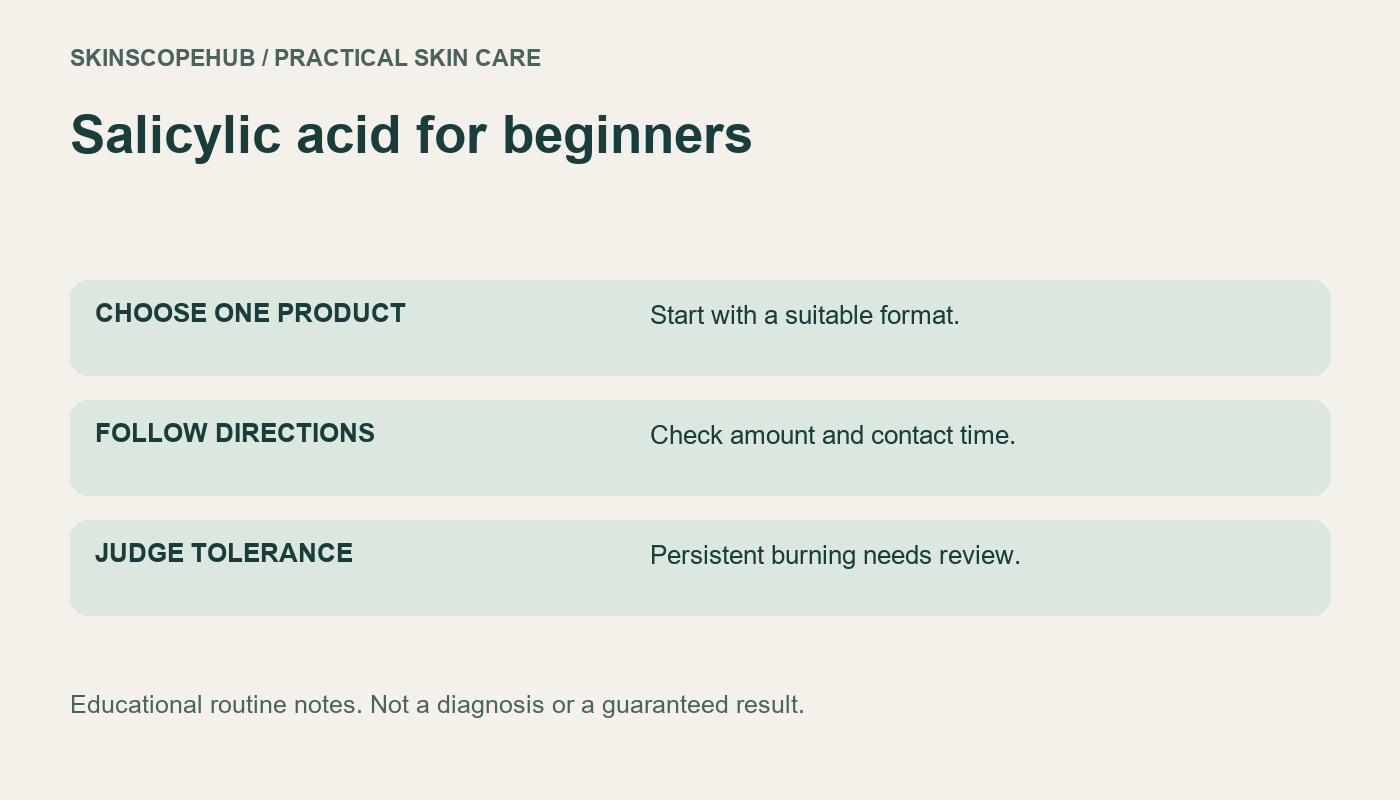
Salicylic acid for beginners starts with one suitable facial product, its label directions, and a routine your skin already tolerates. A cleanser and a leave-on treatment are different exposures. There is no universal concentration or twice-weekly schedule that fits every formula and person.
This first-product guide explains five checks before buying, how to introduce a suitable formula, and when to stop rather than pushing through irritation. For the ingredient’s action, see our salicylic acid explanation.
Is an exfoliating product the next useful step?
Salicylic acid is a keratolytic ingredient used in suitable products for concerns such as blackheads and whiteheads. DermNet’s guidance explains its use and cautions. It is not a treatment for every bump, rash, or type of acne.
If your face is already burning, broken, or covered by a new rash, adding an acid can make it harder to understand the problem. Keep familiar gentle care and seek advice for persistent symptoms. A product marketed for beginners is not automatically appropriate for irritated skin.
Deep painful acne, scarring, or a persistent unfamiliar eruption needs assessment. Do not repeatedly increase exfoliation when the concern may require a different treatment.
5 first-product checks for salicylic acid for beginners
1. Check the intended area and concern
Choose a facial product intended for the concern you have. Salicylic acid also appears in medicines for warts and calluses; those are not interchangeable with facial acne products. Read the actual local package rather than relying on the ingredient name.
Check age restrictions, warnings, and whether it is intended for spots or wider application. For pregnancy, breastfeeding, children, prescription combinations, or extensive treatment, ask a clinician or pharmacist about the exact formula and exposure.
2. Distinguish cleanser from leave-on treatment
A cleanser is used and rinsed away according to its instructions. A leave-on product remains on skin for its intended use. A higher-strength rinse-off formula cannot be directly ranked against a lower-strength leave-on treatment by percentage alone.
Check contact time, amount, and frequency. Do not leave cleanser on longer to make it work like a serum, and do not automatically apply a spot treatment all over the face.
3. Compare more than concentration
The vehicle, other ingredients, application area, and schedule influence comfort. A high percentage is not a necessary goal. Fragrance, other exfoliants, and the feel of the finished formula can also matter to reactive skin.
If you have a known allergy, follow the specific avoidance instructions you received. A short ingredient list or “natural” label does not guarantee suitability.
4. Check for duplicates in your routine
Look for salicylic acid in your current cleanser, toner, serum, and spot product. One new bottle can create a second or third exposure without you realizing it. Retinol and other acne treatments also need tolerance review.
Do not start several active products together. Our layering guide explains combinations, and the retinol combination guide focuses on potentially overlapping irritation. Follow prescribed directions before generic routine advice.
5. Plan a modest introduction
Keep familiar cleanser, moisturizer, and sunscreen while trying one suitable product. Use it within the label’s instructions; when the directions allow less frequent introduction, that can help you judge comfort. Do not automatically increase on a fixed weekly schedule.
For a suitable cosmetic, the AAD small-area product testing guide explains a home use test. Follow product-specific directions, and remember that a home test cannot rule out all reactions or replace medical allergy testing.
A starter routine with fewer moving parts
If using a medicated cleanser, use and rinse it as directed before leave-on skin care. If using a leave-on treatment, cleanse gently and apply the treatment in the intended amount and area before other steps when its directions agree. Use a tolerated moisturizer as needed.
In the morning, use adequate broad-spectrum SPF 30 or higher and follow reapplication directions. Our sunscreen guide helps compare textures. Oily skin may still need moisturizing when treatment causes dryness.
A toner, scrub, cleansing brush, and second acid are optional exposures rather than required steps. The AAD acne guidance explains why aggressive washing and scrubbing can worsen acne.
How to review salicylic acid for beginners
Separate comfort from effectiveness. Track persistent stinging, tightness, itching, scaling, and a new rash alongside the acne concern you chose. Stop the new product if discomfort persists, and return to familiar gentle care while arranging advice when needed.
The AAD advises allowing an appropriate acne product six to eight weeks for some improvement, with clearing often taking longer. This is not a promise for every salicylic acid formula and does not mean you should endure a worsening reaction. Our routine progress guide explains useful review points.
New spots are not automatically purging. Our purging versus irritation guide explains why symptoms and timing cannot always settle the cause at home.
Common beginner questions
Must I start at a particular percentage?
No universal percentage fits every person and format. Choose a suitable labeled product and ask for advice when a condition or medicine changes your options.
Should every beginner use it twice weekly?
No. The exact product directions take priority. A fixed schedule copied from another routine may not match your bottle.
Can I continue if it burns?
Persistent burning is a reason to stop and reassess. Use our irritated skin guide for gentle routine examples and seek advice for ongoing symptoms.
When is prompt care needed?
Significant swelling, blistering, severe pain, or eye involvement needs prompt assessment. Breathing difficulty or swelling of the lips, tongue, or throat requires emergency care.
Sources and editorial basis
SkinScopeHub prepared this first-product checklist using the linked DermNet and AAD guidance. It is not a personalized prescription or a product trial, and has not been medically reviewed. See our medical disclaimer.