A salicylic acid routine should be reviewed by comfort, acne changes, and the product’s directions rather than a guaranteed week-by-week transformation. Start with one suitable product and familiar gentle basics. Persistent burning or a spreading rash is a reason to stop the new exposure, not proof that it is working.
This guide focuses on monitoring an existing routine. For choosing your first bottle, read our salicylic acid beginner guide. No before-and-after results or fixed percentage improvement are claimed here.
Before starting a salicylic acid routine
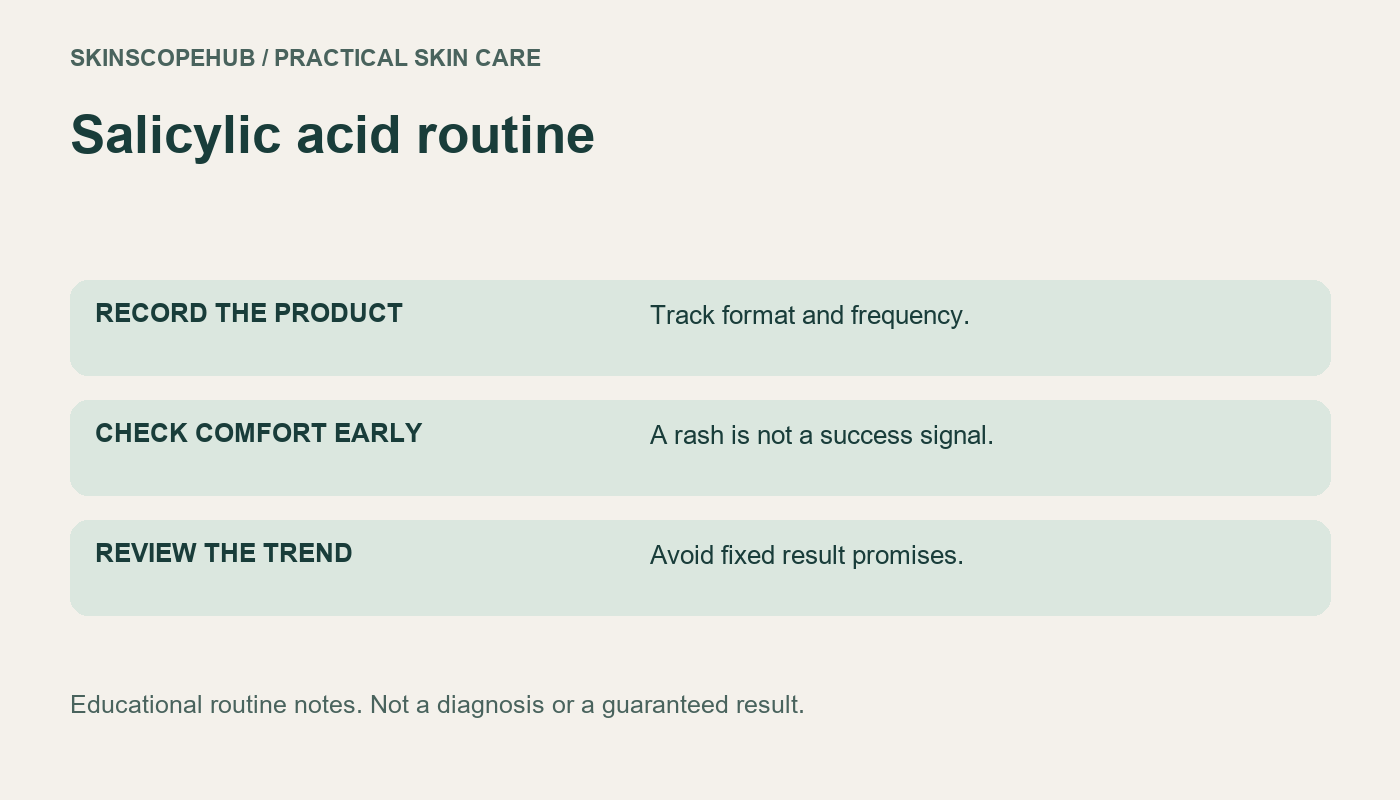
Record the exact product, whether it is rinse-off or leave-on, its label instructions, and other acne treatments you use. Note where clogged pores or inflamed lesions appear and whether you already have dryness, itching, or a rash.
DermNet’s salicylic acid guidance describes a keratolytic ingredient and stresses appropriate label use. Concentration, intended area, amount, and contact time can differ. Do not apply a wart or callus remover to your face.
Seek advice before adding the product if you have significant irritation, a relevant allergy, extensive affected skin, or a medical condition that changes what you can use. For pregnancy, breastfeeding, children, or prescription combinations, ask a clinician or pharmacist about the exact product and intended exposure.
4 useful review points for a salicylic acid routine
1. At introduction: preserve a clear baseline
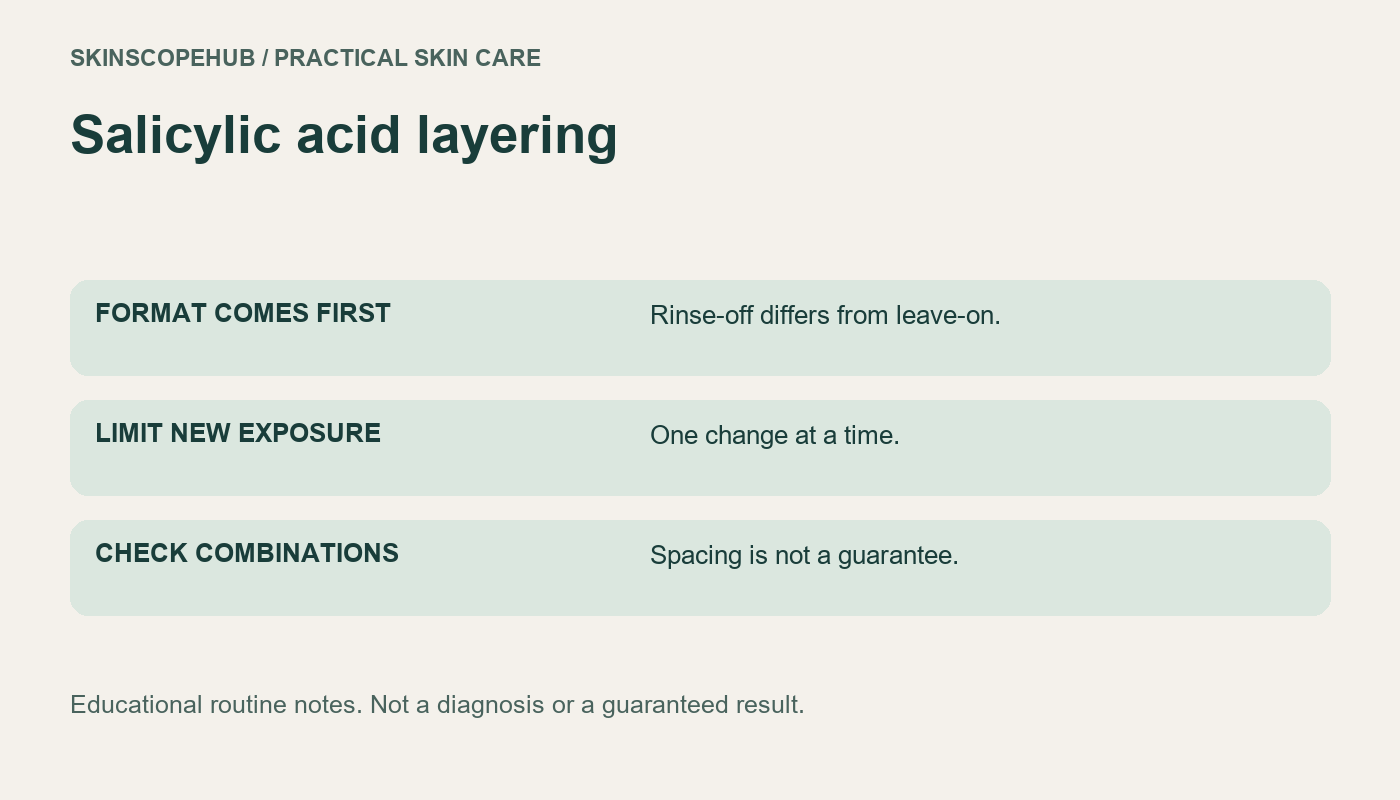
Keep your familiar cleanser, moisturizer, and sunscreen. Introduce one suitable salicylic acid product according to its directions instead of simultaneously changing several steps. A serum, medicated cleanser, and exfoliating toner used together can increase exposure without a clear benefit.
Use no more than the label permits. If the directions allow a less frequent introduction, that can help you judge comfort. Do not automatically increase every week: skin response and the product’s intended use matter more than a calendar.
2. During early use: review symptoms separately from effectiveness
Check for tightness, persistent stinging, itching, scaling, swelling, and a new rash. A product can be ineffective without irritating you, or irritating without improving acne. These are separate observations, so record both.
If the new product causes ongoing discomfort, stop it and return to familiar gentle care. Our skin barrier repair guide explains a simple routine. Seek help if symptoms persist or worsen. There is no requirement to endure a rash for a trial period.
3. After a consistent trial: compare the trend
The AAD acne guidance advises giving an appropriate acne product six to eight weeks to see some improvement, with complete clearing often taking longer. That is broad acne-care guidance, not a promise for every salicylic acid formula or a reason to ignore adverse effects.
Compare occasional photographs in similar lighting and track whether new lesions continue to form. Consider comfort, the number and type of lesions, and whether acne is causing marks or scars. One good day or an unusually harsh photograph cannot establish a trend.
4. At maintenance or reassessment: choose the next useful step
If a suitable routine is comfortable and helping, keep it simple rather than adding stronger exfoliation. Follow the label for ongoing use. You do not need to eliminate every visible pore to consider the routine useful.
If it is not helping, review adherence and suitability with a clinician rather than repeatedly increasing frequency. Deep painful acne, scarring, or persistent inflammation can require different treatment. A salicylic acid routine is not a complete answer to every acne pattern.
A practical progress record
| Record | Example of useful detail | Why it matters |
|---|---|---|
| Product exposure | Product name, rinse-off or leave-on, actual frequency. | Prevents hidden duplication. |
| Comfort | Stinging, itching, scaling, or none. | Separates adverse effects from acne. |
| Acne trend | New lesions and whether deep or painful. | Helps identify need for assessment. |
| Other changes | New medicine, exercise equipment, another serum. | Avoids attributing every change to one product. |
This is an editorial record template, not a diagnostic score. You do not need to count every pore or inspect your face repeatedly each day. A concise record can be more useful when bringing your routine to a dermatologist.
Keep the rest of the routine interpretable
Moisturize if needed, including on oily skin when treatment causes dryness. Use adequate broad-spectrum SPF 30 or higher and follow reapplication directions. Avoid harsh scrubs, brushes, and repeated washing to try to accelerate results.
If retinol, benzoyl peroxide, or another acne medicine is already part of your routine, check the combination with its directions and prescriber. Our layering guide discusses overlapping exposures, and our retinol combination guide explains tolerability concerns.
Questions about routine progress
Is more acne always purging?
No. New spots can have several explanations. Burning, swelling, and a rash deserve attention. Read our purging versus irritation guide before assuming an adverse response must be endured.
Should I move to daily use automatically?
No. Follow the label and your skin’s response. A comfortable schedule that stays within directions can be preferable to increasing exposure without a reason.
Can I expect a fixed change by week twelve?
No. We do not have evidence establishing a universal percentage or deadline for all formulas and acne types. Reassess a persistent concern rather than relying on a transformation promise.
When is waiting inappropriate?
Seek prompt care for severe swelling, blistering, intense pain, or eye involvement. Deep painful lesions and scarring warrant clinical advice. Breathing difficulty or swelling of the mouth or throat needs emergency help.
Sources and editorial basis
SkinScopeHub prepared this monitoring guide using the linked AAD and DermNet guidance. No personal treatment journey or clinical outcome data are claimed. The article has not been medically reviewed; see our medical disclaimer.