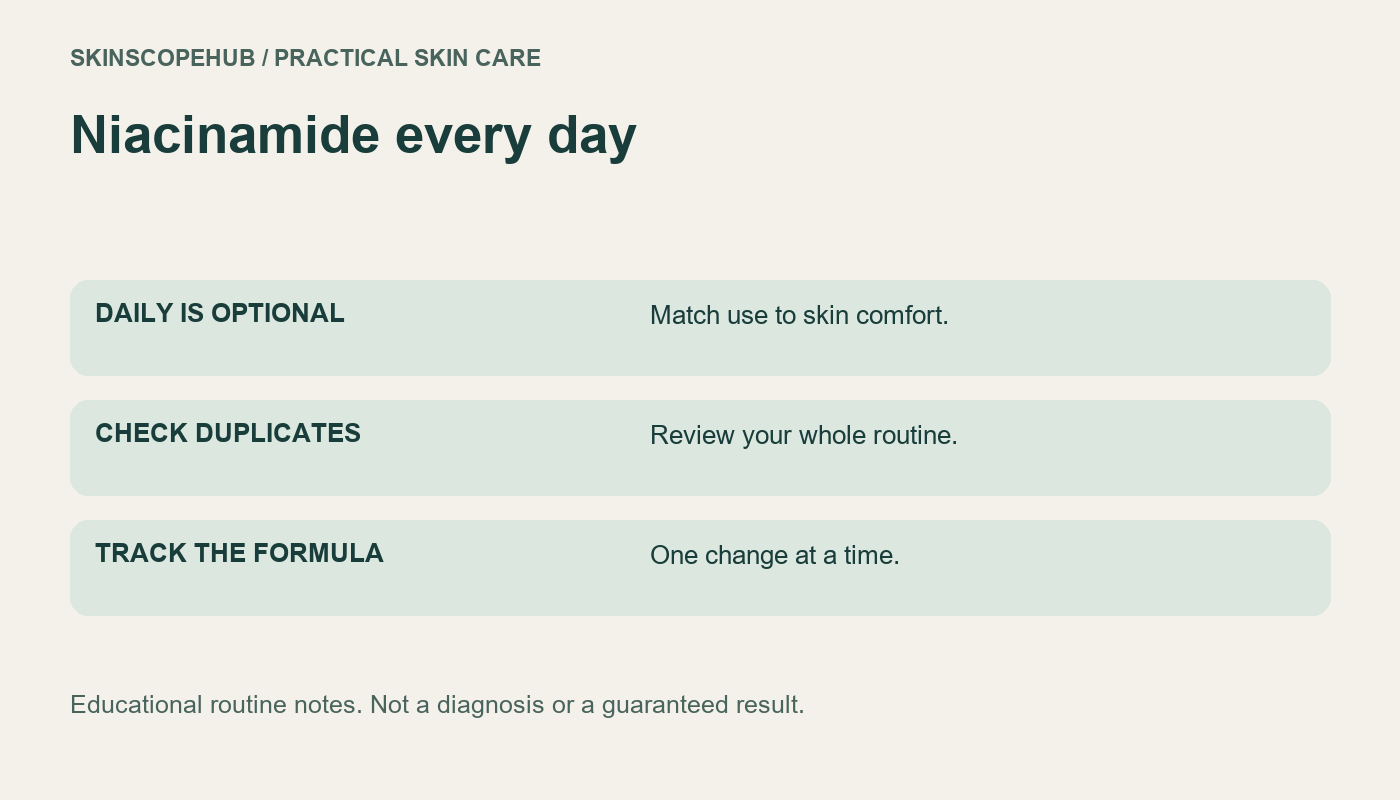
You may be able to use niacinamide every day when the complete product suits your skin and its directions permit daily use. Twice-daily application is not necessary for everyone. If a formula causes persistent stinging, dryness, or a rash, increasing frequency is not the next step.
Niacinamide is often already present in moisturizers and sunscreens. This guide covers seven checks for a sustainable schedule, what one clinical study actually measured, and how to judge comfort separately from longer-term cosmetic results.
What research can tell you about daily use
DermNet’s nicotinamide overview discusses topical niacinamide in several formulations and its potential roles in hydration, barrier function, and visible skin changes. Those effects do not make every serum universally suitable.
A 2006 clinical study of 2% niacinamide moisturizer measured facial oil in separate Japanese and US groups. In the Japanese comparison, sebum excretion rates were lower after two and four weeks in the treated group. In the US split-face study, casual sebum levels fell after six weeks, but sebum excretion rates did not significantly fall.
These are different measurements and results. The study does not prove that all users become less oily within two weeks, that every percentage is equivalent, or that a niacinamide serum will prevent acne. It is evidence about specific formulas, groups, and outcomes.
7 checks before using niacinamide every day
1. Read the complete product label
Check whether the product is a cleanser, leave-on serum, moisturizer, or sunscreen. Follow its amount, application area, and frequency. A formula can contain niacinamide alongside other ingredients with their own limits, including exfoliants.
Do not transfer the schedule from a simple moisturizer to a formula containing several active ingredients. The full product is what you apply, not only the niacinamide percentage advertised on the box.
2. Check for duplicate steps
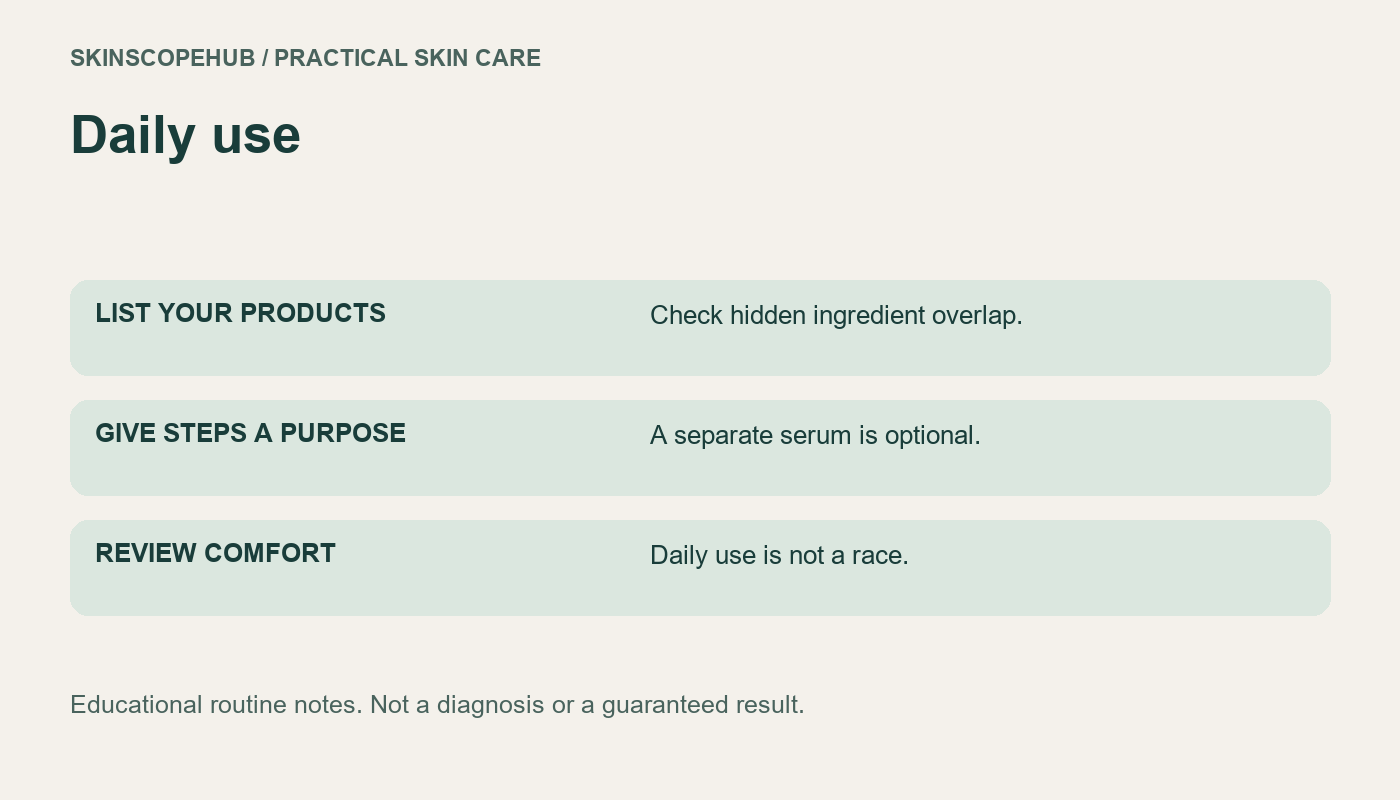
If niacinamide is already in a cream you tolerate, a separate serum is optional. Adding it to morning and evening products does not automatically improve results. Keep the routine small enough to understand which products help and which cause problems.
Our niacinamide ingredient guide explains its broader uses. Identify a specific concern before buying another bottle for the same ingredient.
3. Compare formulas rather than chasing strength
A higher concentration is not a necessary progression. Vehicle, fragrance, other actives, amount, and frequency all affect suitability. A comfortable modest-concentration moisturizer may make more sense than a stronger serum that stings.
Published results for 2%, 4%, or 5% formulas cannot establish that 10% is twice as effective or universally appropriate for oily skin. There is no need to escalate when your current routine meets your needs.
4. Introduce one product clearly
Keep familiar cleansing and moisturizer while trying a new formula. The AAD’s small-area product test guidance describes testing suitable skin care for seven to ten days, using normal amounts and relevant rinse-off directions.
This home test cannot rule out every allergy or predict facial acne. Follow specific medicine directions, and do not deliberately retest a formula after a severe reaction.
5. Choose morning or evening for convenience
A suitable leave-on serum commonly fits after cleansing and before moisturizer, when its label agrees. A cream containing niacinamide is used at the moisturizer step. There is no universal reason everyone must use both morning and evening applications.
In the morning, finish with adequate sunscreen as directed. Niacinamide does not replace SPF. A simpler set of layers can also reduce pilling; do not solve pilling by applying less sunscreen than recommended.
6. Keep other actives stable
Do not increase retinol, acids, or acne medicine while introducing a new niacinamide product. If discomfort develops after several simultaneous changes, the cause becomes difficult to identify. Follow prescription instructions and discuss adverse effects with the prescriber.
Read our salicylic acid layering guide when reviewing several actives. Niacinamide cannot guarantee that an irritating combination becomes comfortable.
7. Review comfort before frequency
Track persistent burning, itching, tightness, scaling, and rash as well as the cosmetic concern. DermNet notes that frequency may need reducing when a topical nicotinamide formula causes excessive dryness. Some reactions warrant stopping the product and getting advice rather than simply reducing use.
If your basic products become uncomfortable, the skin barrier repair guide gives a simple routine example. Persistent or recurrent symptoms may need assessment for a skin condition or allergy.
A schedule decision table
| Situation | What to consider |
|---|---|
| You tolerate a daily niacinamide moisturizer. | Keep using it as directed; another serum may be unnecessary. |
| You are introducing a new leave-on product. | Check the label, test appropriately, and keep other products stable. |
| A twice-daily formula feels drying. | Review frequency and suitability; ask for advice when symptoms persist. |
| You develop a new rash or significant discomfort. | Stop the new optional product and assess the reaction. |
This table helps organize product decisions; it does not prescribe treatment for a diagnosed condition. If you have eczema, rosacea, contact allergy, or ongoing acne, your clinician’s plan takes priority.
Judge results without a fixed transformation calendar
Hydration, oil measurements, visible pigmentation, and fine lines are different outcomes. A study’s review date is not a guarantee that your skin will change on the same schedule. Compare one concern in similar lighting and avoid changing the routine every few days.
Do not describe niacinamide every day as a guaranteed twelve-week transformation. If a comfortable product provides no useful benefit, you can review whether it needs a place in your routine rather than automatically increasing strength.
Common questions about niacinamide every day
Is using it once a day enough?
There is no universal dose for all cosmetic goals and formulations. Follow the label and choose a schedule that is comfortable and sustainable; twice-daily use is not an automatic requirement.
Does daily niacinamide cause purging?
Do not automatically call new spots purging. Niacinamide is not a retinoid or exfoliating acid. Our purging versus irritation guide explains how to review symptoms and product changes.
Can I use it when pregnant?
This guide concerns topical skin care rather than supplements. Check the complete formula and discuss products or medicines with your clinician when you have pregnancy-specific questions.
When should I seek medical help?
Significant swelling, blistering, severe pain, a spreading rash, or eye involvement needs prompt care. Trouble breathing or swelling of the lips, tongue, or throat requires emergency help.
Sources and editorial basis
Updated by SkinScopeHub using the linked DermNet, AAD, and trial sources. Findings are described with their formulation and outcome limits; no first-hand testing or medical review of this article is claimed. Read our medical disclaimer.