
Can you use niacinamide and salicylic acid together? Yes — and research suggests they actually make one of the best ingredient pairings in modern skincare. But there is a catch: the order you apply them, the timing, and the pH of each product all determine whether this powerful duo clears your skin or irritates it. This guide breaks down exactly how niacinamide and salicylic acid interact at the molecular level, three research-informed methods to combine them, and the common mistakes that cause redness and peeling when layering these two ingredients.
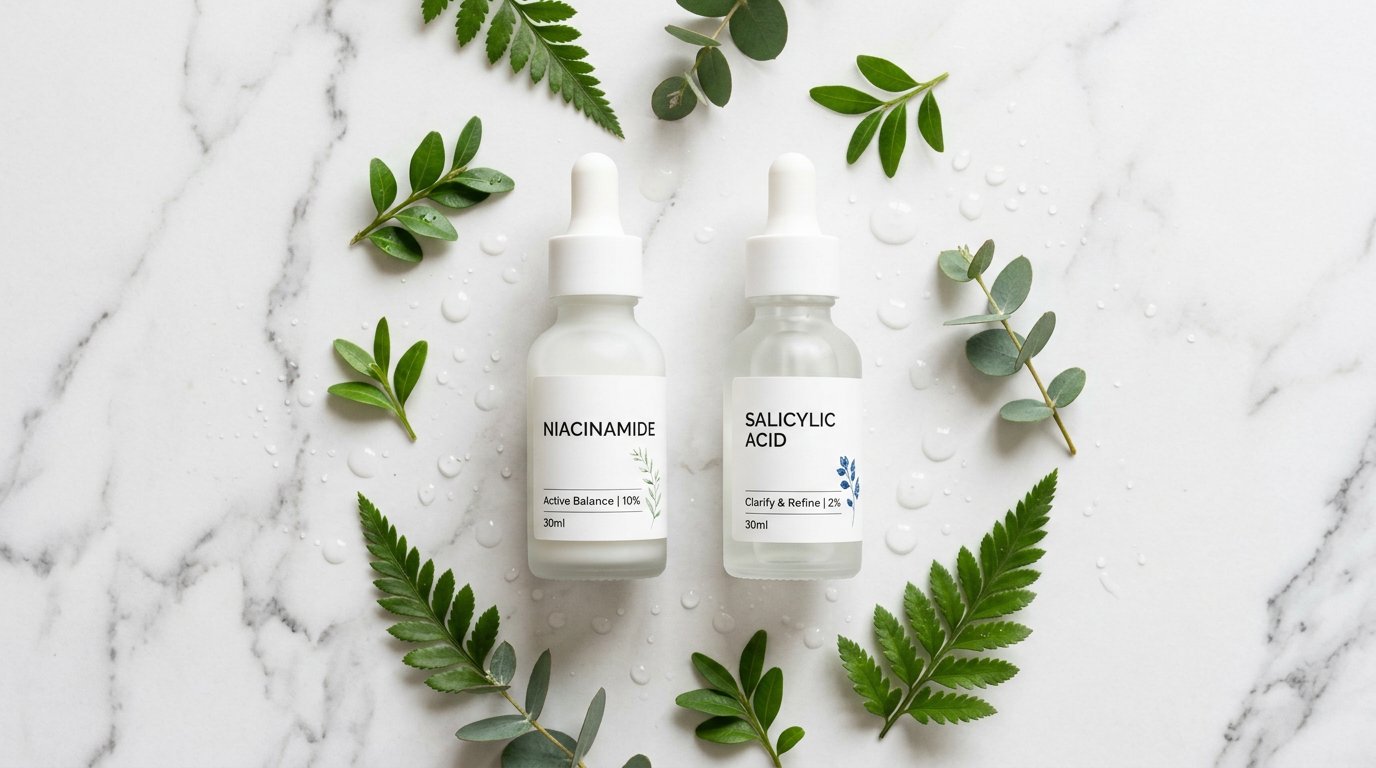
If you have been wondering whether you can use niacinamide and salicylic acid together without ruining your skin barrier, you are not alone. This is one of the most searched skincare questions online — and there is a surprising amount of outdated misinformation about it.
The short version: salicylic acid is oil-soluble and works inside the pore; niacinamide is water-soluble and works on the barrier and tone. One cleans the drain, the other repairs the pipe. That is why they pair well — and why the order matters more than the products you buy.
Key Takeaways: Can You Use Niacinamide and Salicylic Acid Together?
- The Golden Rule: Yes, you can layer them — provided you respect their different pH levels. Salicylic acid needs an acidic environment to work; niacinamide is happiest near neutral.
- The Waiting Period: Salicylic first, then wait 20 minutes before niacinamide. That gap lets the acid finish working at its own pH instead of being neutralized on contact — and it is also what keeps flushing and stinging down.
- The Acne Benefit: A 21-day study of a gel containing 2% salicylic acid alongside niacinamide, glycolic acid, lactic acid and ceramides reported a 23.81% improvement in investigator-rated acne severity (IGA), alongside a 49.26% drop in water loss — the barrier-support signal that makes this pairing interesting for daily use.
Can You Use Niacinamide and Salicylic Acid Together? The Short Answer
Yes — you can use niacinamide and salicylic acid together safely and effectively. They complement each other: salicylic acid unclogs pores and reduces oil, while niacinamide calms inflammation and repairs the skin barrier that salicylic acid can temporarily weaken.
A 2025 study in the Journal of Cosmetic Dermatology tested a gel built around 2% salicylic acid — plus 2.9% glycolic acid, 2.5% lactic acid, niacinamide and three ceramides — on 42 participants with mild-to-moderate acne and oily or combination skin. Worth being precise here: this was a multi-acid formula, not a pure salicylic-plus-niacinamide test, so read the numbers as the result of a complete routine rather than one ingredient pair. The results after 21 days:
- Investigator-rated acne severity (IGA) improved by 23.81%
- Sebum production dropped by 23.65%
- Skin hydration increased by 40.5%
- Transepidermal water loss (TEWL) decreased by 49.26%
- 100% of participants reported satisfaction with the product
Source: PMC12274963
The one critical rule: do not mix them in your palm and apply simultaneously. They work best at different pH levels, so layering niacinamide and salicylic acid at the same time reduces effectiveness. Separate them by time of day or wait 20–30 minutes between applications.
What Does Niacinamide Actually Do to Your Skin?
Niacinamide — also known as vitamin B3 or nicotinamide — is a water-soluble vitamin that strengthens your skin from the inside out. Here is what peer-reviewed research confirms:
Strengthens the skin barrier. Niacinamide increases ceramide production — the lipids that hold your skin cells together and prevent moisture loss. A 2025 study published in Nature Scientific Reports found that 5% niacinamide penetrates the stratum corneum and modifies keratin structure, increasing hydration at the cellular level.
Regulates oil production. Studies show 2–5% niacinamide reduces sebum excretion rate in oily skin after 4 weeks of consistent use.
Reduces inflammation. Niacinamide suppresses inflammatory cytokines (IL-6, TNF-α), making it effective for calming redness from active breakouts, visible redness, and post-procedure irritation.
Fades dark spots. It inhibits melanosome transfer from melanocytes to keratinocytes — meaning it slows the delivery of pigment to the skin surface without bleaching.
Minimizes pore appearance. Through the combination of oil regulation and improved skin elasticity, pores look visibly smaller.
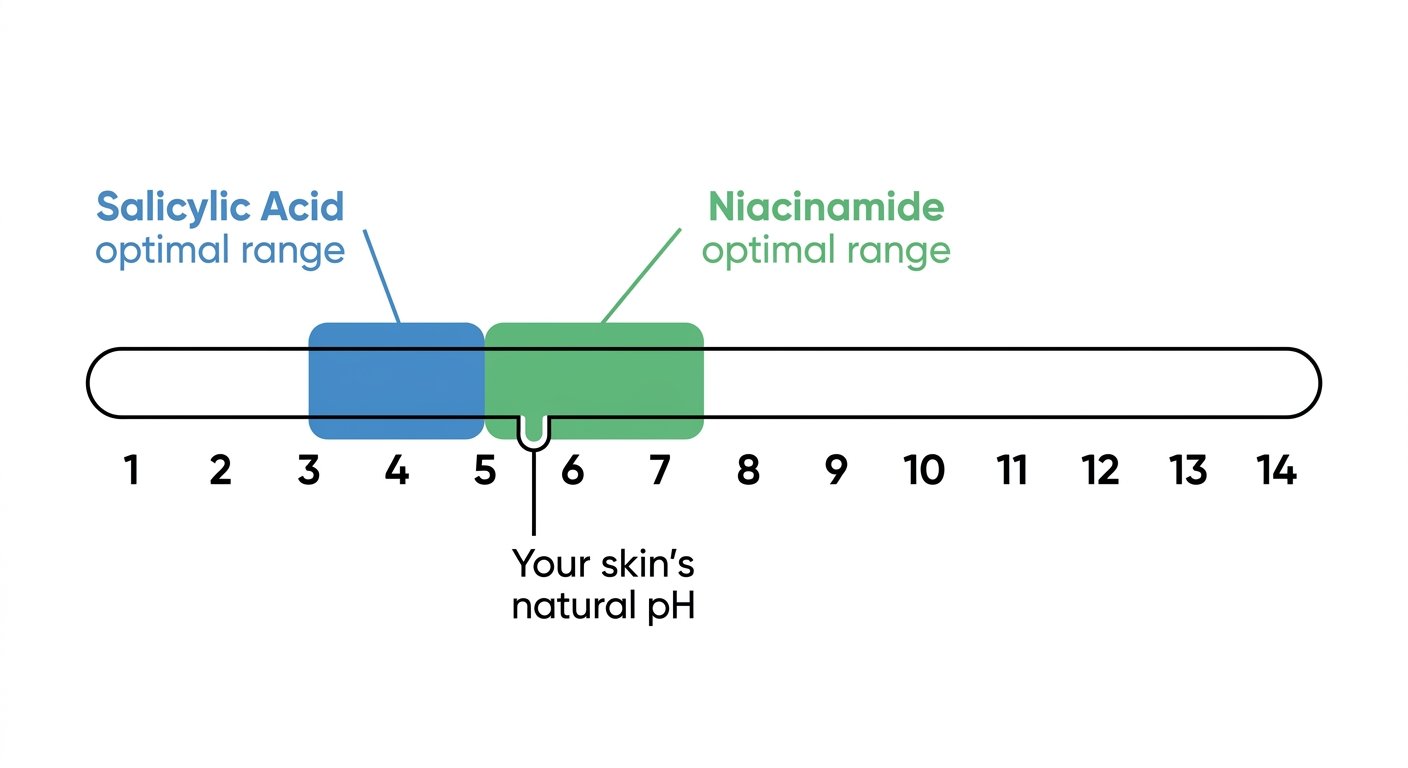
Niacinamide works best at a pH between 5.0 and 7.0 — close to your skin’s natural pH of 5.5. This makes it compatible with most moisturizers and sunscreens.
Optimal concentration: 2–5% for most concerns. Higher concentrations (10%+) are not necessarily better and may cause flushing in sensitive users.
What Does Salicylic Acid Do to Your Skin?
Salicylic acid is a beta-hydroxy acid (BHA) derived from willow bark. Unlike AHAs (glycolic acid, lactic acid), salicylic acid is oil-soluble — it penetrates through sebum directly into the pore lining. This is why salicylic acid shows up in so many oil-control and blemish-prone routines — it reaches the pore lining in a way water-soluble acids cannot.
If you want to dive deeper into how salicylic acid works, read our complete salicylic acid guide.
Here is what salicylic acid does at the cellular level:
Dissolves pore blockages. It breaks down desmosomes — the protein structures holding dead skin cells together inside pores — allowing them to shed instead of clumping into plugs.
Reduces sebum production. Because salicylic acid is oil-soluble, it reaches the sebaceous glands through the follicular canal and reduces oil output at the source.
Anti-inflammatory effect. Salicylic acid is structurally related to aspirin (acetylsalicylic acid), which explains its ability to calm redness and swelling around active pimples.
Prevents new comedones. By keeping pore linings clear, it stops new blackheads and whiteheads from forming — not just treating existing ones.
Salicylic acid works best at a pH between 3.0 and 4.0. At this acidic pH, the molecule stays un-ionized — the form that actually penetrates skin. Above pH 4.0, it becomes ionized and significantly less effective.
Optimal concentration: 0.5–2% for daily over-the-counter products. For more on how to combine salicylic acid with other actives, see our salicylic acid layering guide.
Why Niacinamide and Salicylic Acid Work So Well Together
Think of salicylic acid as the demolition crew and niacinamide as the construction team. Salicylic acid goes in first, breaks down pore blockages, clears excess oil, and reduces inflammation. Niacinamide follows, repairing the barrier, restoring hydration, and calming any irritation that exfoliation triggered.
Here is a side-by-side comparison showing why you can use niacinamide and salicylic acid together for better results than either alone:
| Function | Salicylic Acid | Niacinamide | Combined Effect |
|---|---|---|---|
| Unclogs pores | ✅ Primary function | ❌ | Pores stay clear |
| Controls oil | ✅ Reduces at gland level | ✅ Regulates at surface | Double oil control |
| Reduces inflammation | ✅ Aspirin-like mechanism | ✅ Cytokine suppression | Faster calming |
| Repairs skin barrier | ❌ Can temporarily weaken | ✅ Boosts ceramides | Niacinamide offsets dryness |
| Fades dark spots | ❌ | ✅ Inhibits melanin transfer | Clears acne + prevents marks |
| Hydrates skin | ❌ Can be drying | ✅ Improves moisture retention | Balanced hydration |
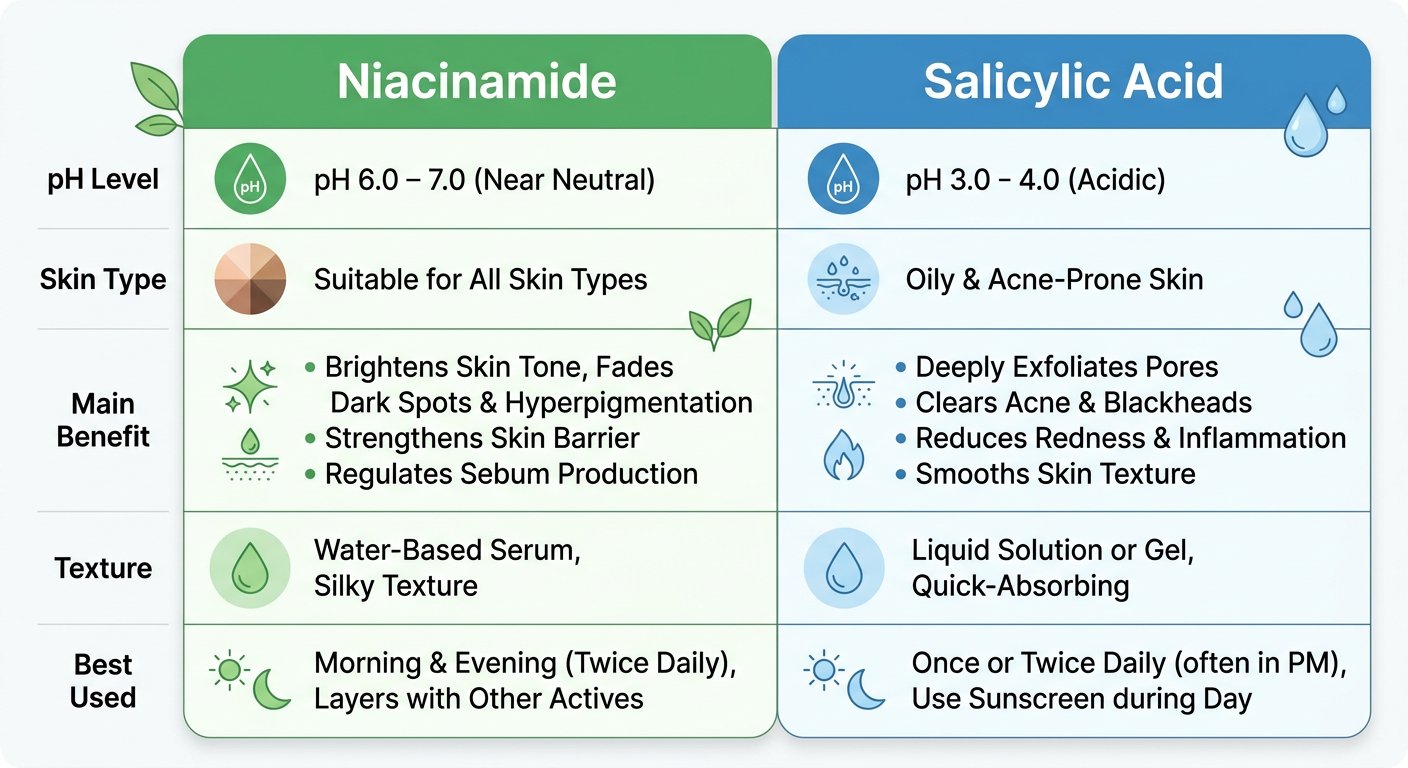
A 2010 study in Current Drug Delivery confirmed that salicylic acid and niacinamide influence each other’s skin permeation when applied together — supporting the recommendation to separate application times for optimal absorption.
The bottom line: salicylic acid handles deep cleaning. Niacinamide handles aftercare. Together, they address acne from two completely different angles.
Wondering how salicylic acid compares to other acne actives? Check our detailed comparison of salicylic acid vs benzoyl peroxide.
The pH Problem: Why Layering Order Matters When You Use Niacinamide and Salicylic Acid Together
This is the most important section of this article. The reason most people experience irritation when they use niacinamide and salicylic acid together is not ingredient incompatibility — it is ignoring pH.
Here is the science:
- Salicylic acid needs a pH of 3.0–4.0 to penetrate pores effectively
- Niacinamide works best at a pH of 5.0–7.0
- Your skin’s natural resting pH is approximately 5.5
When you apply salicylic acid, it temporarily drops your skin’s surface pH to around 3.5. This is necessary for the acid to work. If you immediately layer niacinamide on top, two problems occur:
Problem 1: Niacinamide raises the pH, neutralizing salicylic acid before it absorbs fully.
Problem 2: At very low pH, niacinamide can partially convert to niacin (nicotinic acid) — a related compound that causes visible flushing, tingling, and temporary redness. This conversion is the origin of the old myth that “you cannot use niacinamide with acids.”
In well-formulated products with proper timing, this conversion is negligible. But slathering niacinamide serum directly onto a wet layer of salicylic acid toner? That creates problems.
The fix is simple: give salicylic acid 20–30 minutes to absorb before applying niacinamide. By then, the acid has done its work inside the pores, and your skin’s pH has returned to ~5.5 — the perfect environment for niacinamide to perform.
3 Research-Informed Ways to Use Niacinamide and Salicylic Acid Together
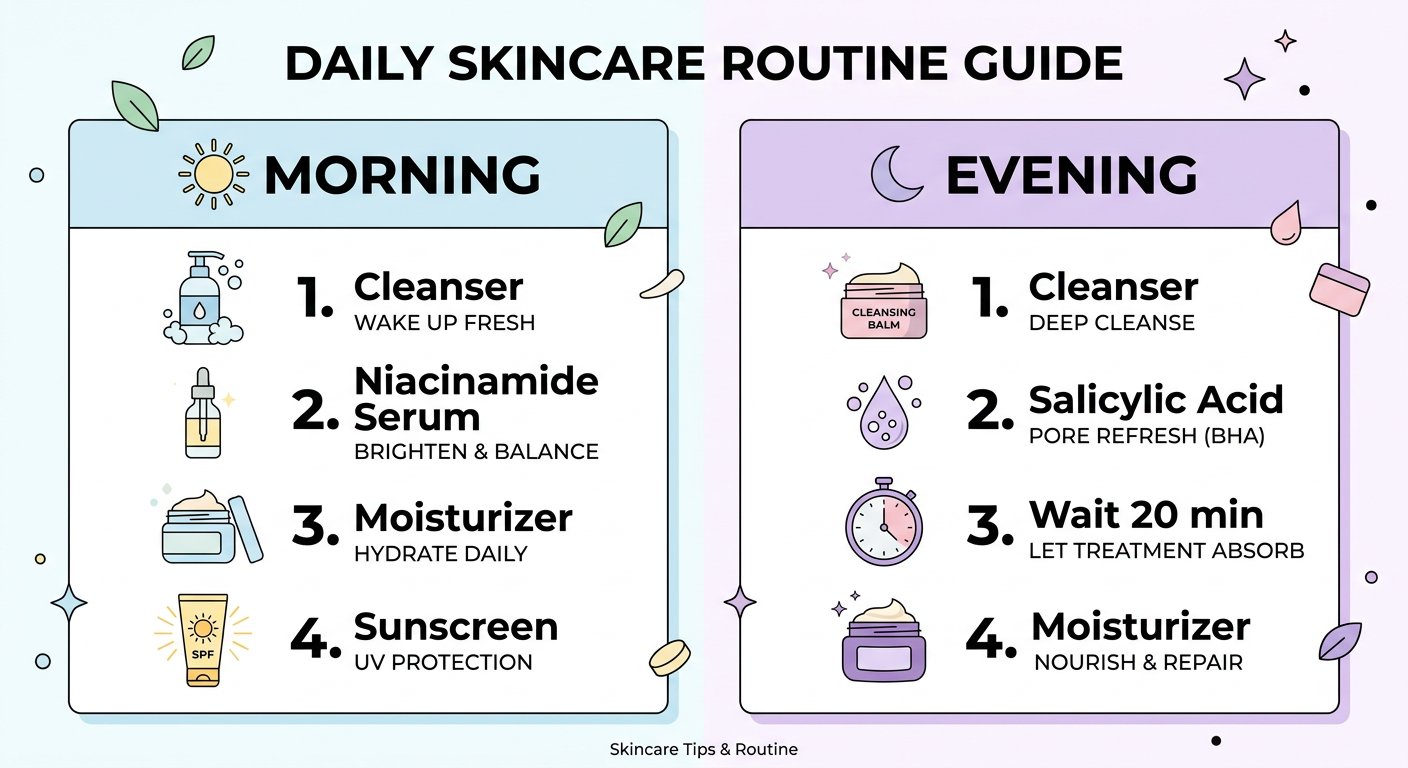
Method 1: AM/PM Split (Best for Beginners)
This is the simplest, safest approach — and the one most experts suggest when patients ask if they can use niacinamide and salicylic acid together.
Morning routine:
- Gentle cleanser
- Niacinamide serum (5%)
- Moisturizer
- Sunscreen SPF 30+
Evening routine:
- Gentle cleanser
- Salicylic acid serum or toner (0.5–2%)
- Wait 20–30 minutes
- Moisturizer
Why this works: niacinamide’s neutral pH matches your morning products perfectly. Salicylic acid gets uninterrupted time overnight. Zero pH conflicts.
Method 2: Same Routine With a Timed Gap (For Experienced Users)
For those who want both ingredients in one session (usually PM):
- Gentle cleanser
- Salicylic acid (2%) on dry skin
- Wait 20–30 minutes — this step is critical
- Niacinamide serum (5%)
- Moisturizer
Skipping that 20–30 minute gap is the number-one cause of redness when people try to use niacinamide and salicylic acid together in the same routine.
Method 3: Alternate Day Rotation (For Sensitive Skin)
If your skin reacts easily, alternate the ingredients instead of layering them:
- Monday, Wednesday, Friday: Salicylic acid in the evening
- Tuesday, Thursday, Saturday: Niacinamide morning and evening
- Sunday: Neither — just cleanser, moisturizer, SPF (recovery day)
This gives your skin the full benefit of each ingredient without any risk of pH interference or overstimulation.
For a full starter routine on using salicylic acid for blemish-prone skin, see our salicylic acid guide.
Who Should Use Niacinamide and Salicylic Acid Together?
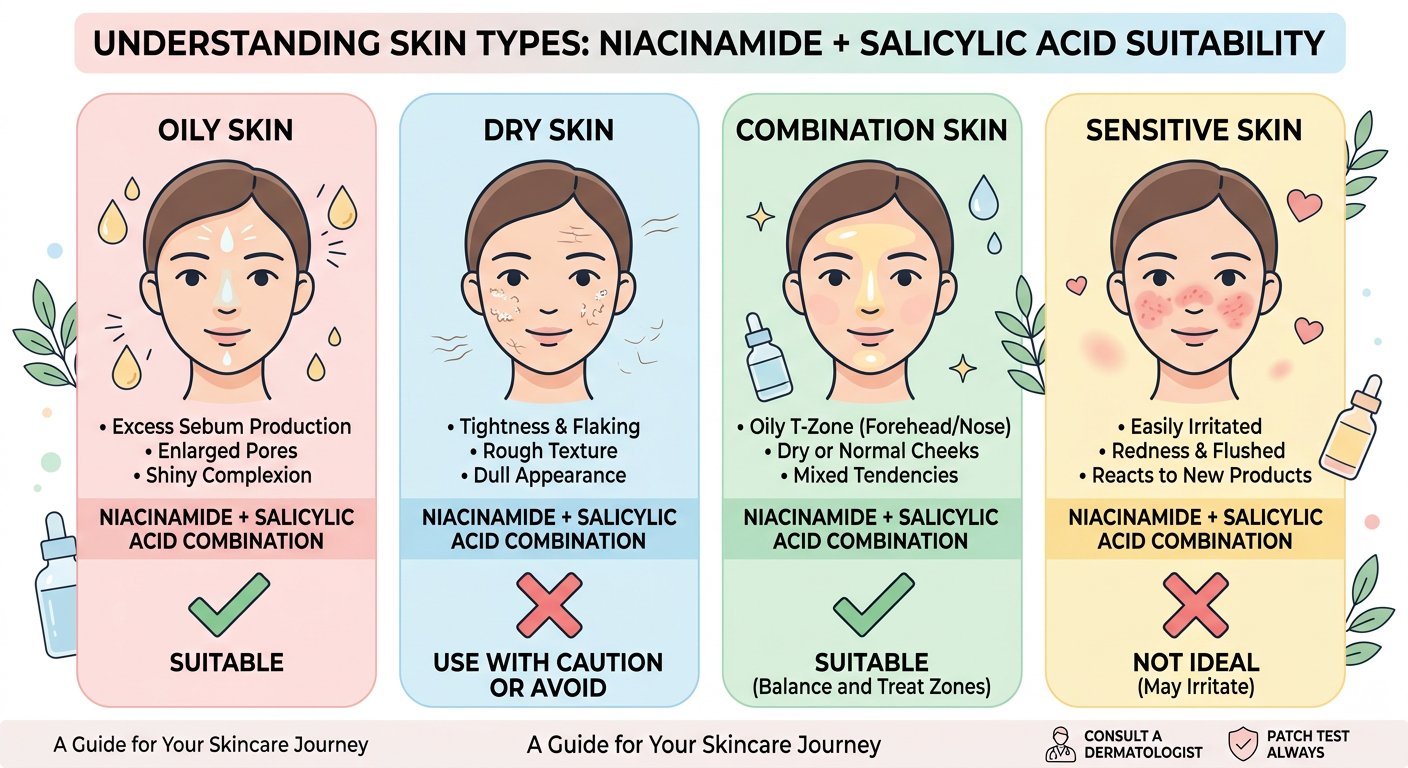
This combination is excellent for:
- Oily, acne-prone skin — dual sebum control from both ingredients
- Combination skin with T-zone breakouts — salicylic acid on the T-zone, niacinamide everywhere
- Post-acne dark spots (PIH) — salicylic acid prevents new breakouts while niacinamide fades existing marks
- Enlarged pores — salicylic acid clears congestion, niacinamide tightens pore appearance
- Teens and adults with mild-to-moderate acne — covers prevention, treatment, and barrier repair in one routine
Who Should NOT Combine These Two Ingredients?
Proceed with caution or skip if:
- You already use prescription retinoids (tretinoin, adapalene). Adding salicylic acid on top risks over-exfoliation. Niacinamide with retinoids is fine. Salicylic acid plus retinoids needs clinician supervision — see salicylic acid with retinol for the timing rules.
- Your skin is currently reactive or sensitive — tight, flaky, stings with moisturizer. Recover first with ceramides and gentle products before adding any acid; niacinamide for sensitive skin covers a lower-and-slower entry point.
- You use multiple exfoliants already — glycolic acid, lactic acid, or retinol plus salicylic acid is too much. Choose one exfoliant and pair with niacinamide.
- Pregnancy or nursing — topical salicylic acid is widely used at 0.5–2% in cleansers, but the evidence for larger areas or higher strengths is limited. Ask your own clinician rather than relying on a general rule from a blog.
5 Common Mistakes When Combining Niacinamide and Salicylic Acid
Mistake 1: Layering them simultaneously without waiting.
Without a 20–30 minute gap, pH conflicts reduce effectiveness and increase flushing risk. This is the single biggest error.
Mistake 2: Starting with high concentrations of both.
Do not begin with 10% niacinamide and 2% salicylic acid at the same time. Start with 5% niacinamide and 0.5–2% salicylic acid. Research consistently shows 5% niacinamide delivers optimal results.
Mistake 3: Adding retinol on the same night.
Salicylic acid plus retinol plus niacinamide in one evening is a recipe for irritation. Alternate salicylic acid and retinol on different nights. Niacinamide is safe with either.
Mistake 4: Skipping moisturizer after salicylic acid.
Salicylic acid is drying. Always follow with moisturizer to prevent transepidermal water loss and barrier disruption.
Mistake 5: Forgetting sunscreen.
While salicylic acid is less photosensitizing than AHAs or retinol, increased cell turnover still leaves fresher, more vulnerable skin exposed. Daily SPF 30+ is non-negotiable.
Frequently Asked Questions About Using Niacinamide and Salicylic Acid Together
Should I apply salicylic acid or niacinamide first?
Salicylic acid first, always. It needs an acidic environment (pH 3–4) to work. Apply to clean, dry skin and wait 20–30 minutes before applying niacinamide.
Can I use niacinamide and salicylic acid together every day?
Most people can tolerate daily use once acclimated. Start with 2–3 times per week and increase gradually. If you notice dryness or redness, scale back. For a frequency-first breakdown, see how often you can use salicylic acid and daily niacinamide use.
Can I use a single product that contains both ingredients?
Yes. Pre-formulated products balance the pH for both ingredients, so no waiting is needed. The trade-off is lower individual concentrations compared to standalone serums.
Is it safe to add vitamin C to this routine?
Yes, but separate it. Use vitamin C in the morning (it enhances sunscreen protection), salicylic acid in the evening, and niacinamide in either AM or PM.
Will this combination cause purging?
Salicylic acid can trigger a temporary purge — small breakouts in areas you typically break out — during the first 2–4 weeks. This means it is clearing existing congestion. Niacinamide does not cause purging.
Can I use niacinamide and salicylic acid together with retinol?
Niacinamide plus retinol is safe and actually recommended — niacinamide reduces retinol irritation. Salicylic acid plus retinol should be used on alternate nights to avoid over-exfoliation.
What percentage of niacinamide works best?
5% is the research-backed sweet spot. It is effective and well-tolerated. Going to 10% or higher increases flushing risk without proportionally better results.
How long until I see results from using niacinamide and salicylic acid together?
Salicylic acid shows visible pore-clearing within 1–2 weeks. Niacinamide benefits — reduced redness, improved texture, fading marks — typically appear at 4–6 weeks, with maximum results at 8–12 weeks of consistent daily use.
Scientific Sources
- Clinical Efficacy of a Salicylic Acid–Containing Gel on Acne. Journal of Cosmetic Dermatology. 2025. PMC12274963
- Niacinamide and its impact on stratum corneum hydration and structure. Nature Scientific Reports. 2025. Link
- Combined patch containing salicylic acid and nicotinamide: mutual effect on skin permeation. Current Drug Delivery. 2010. PMID: 20950260
- Effect of pH on niacinamide skin permeation. Nature Scientific Reports. 2026. Link
Written and edited by the SkinScopeHub editorial team. Reviewed for accuracy against the sources listed above. Last updated: October 2026.
Disclosure: SkinScopeHub is reader-supported. When you buy through links on our site, we may earn an affiliate commission at no extra cost to you. Learn more.