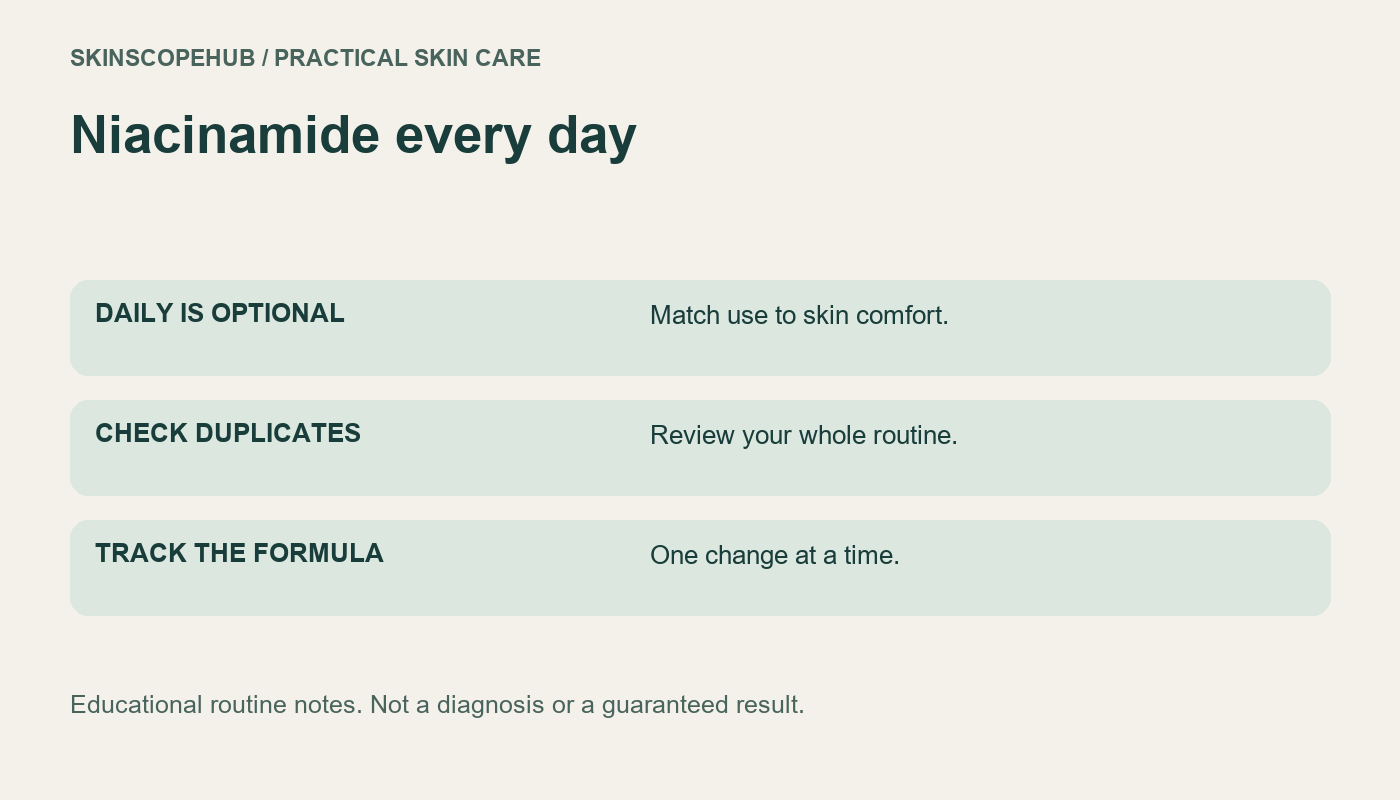
Niacinamide daily use should fit the actual products in your routine, their directions, and your skin’s comfort. You may already use it in moisturizer or sunscreen. A separate serum is optional, and adding several niacinamide products does not automatically improve results.
This guide focuses on auditing an existing routine for duplication, layering, and reactions. For the basic daily-frequency question and research limits, see our niacinamide every day guide.
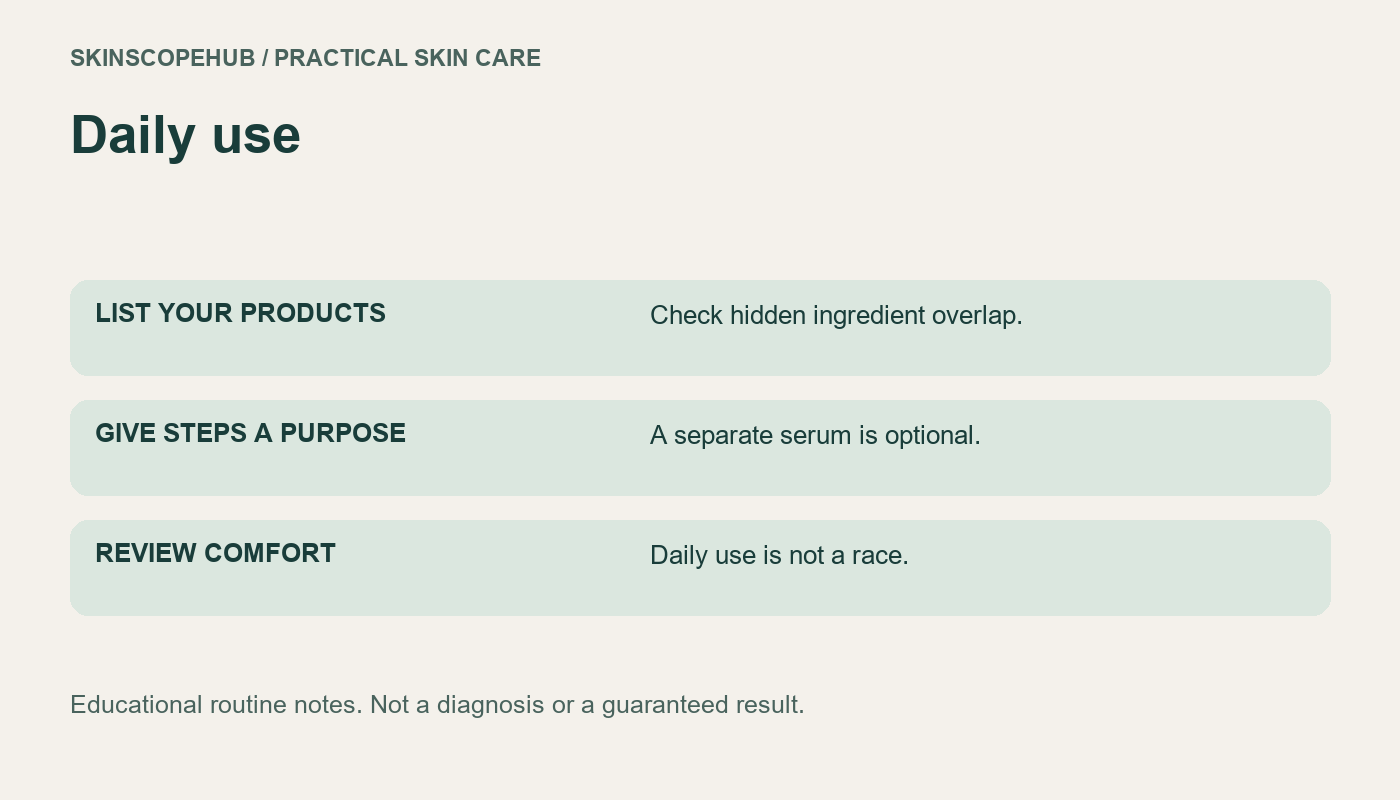
5 simple steps to review daily use
1. Make a complete product list
Write down your cleanser, toner, serum, moisturizer, sunscreen, and acne treatments. Check the ingredient lists for niacinamide rather than assuming it appears only in a bottle with that ingredient on the front. Similar active claims can hide different complete formulas.
Record when and how often you use each product. This makes it easier to understand what changed if you develop discomfort. Daily use of one comfortable moisturizer is a different exposure from several independent serums and creams layered twice a day.
2. Give each product a clear purpose
A moisturizer can address dryness through several ingredients. A sunscreen supplies protection when used appropriately. A niacinamide serum is an extra cosmetic step, so identify the concern it is meant to help before keeping it automatically.
DermNet’s nicotinamide overview discusses topical niacinamide and selected research. Its inclusion in skin care does not mean a separate daily-use serum is essential for every person or that it treats every cause of redness.
3. Compare formula and concentration together
A higher number does not automatically make a product more useful. A study of a 2% niacinamide moisturizer measured oil-related outcomes in specific groups over four to six weeks. It did not establish a universal best percentage or prove that a 10% serum must work better.
The vehicle, other ingredients, amount, and frequency affect comfort. If you have a known contact allergy, check the actual ingredients you were told to avoid. Fragrance-free can be a useful starting point for reactive skin, but is not a guarantee.
4. Review placement and unnecessary layers
Follow the actual product directions. A niacinamide serum commonly fits after cleansing and before moisturizer; niacinamide already included in a cream belongs at the moisturizer step. A cleanser containing it is rinsed off, so its role differs again.
If products pill, check amount, drying time, and the number of optional layers. Remove an unnecessary serum before reducing sunscreen below its directed amount. Our sunscreen guide explains why adequate application matters.
5. Review comfort before changing frequency
Track persistent stinging, itching, tightness, scaling, or a new rash. Daily use is not a target you must reach despite discomfort. Follow the label and any clinical advice; a less complicated routine may be more suitable.
If a new product causes persistent irritation, stop it and use familiar gentle basics. Our skin barrier repair routine provides an example. A recurring or spreading reaction needs assessment rather than repeated experimentation.
A routine audit you can use
| Product | Question to ask | Possible action |
|---|---|---|
| Niacinamide serum | Does it add a useful goal beyond my moisturizer? | Keep only if useful and tolerated. |
| Moisturizer | Does the whole formula keep skin comfortable? | Judge more than the advertised active. |
| Sunscreen | Can I apply the directed amount? | Preserve adequate protection. |
| Other active treatment | Did I change it at the same time? | Avoid multiple new exposures together. |
This is an editorial checklist, not a prescribed routine. Someone with eczema, rosacea, acne medicines, or a known allergy may need different advice. Keep prescribed treatment instructions in view when reviewing optional cosmetic products.
Daily use alongside acids, retinol, or vitamin C
Niacinamide can appear with other ingredients in a finished formula. That is different from applying several separate bottles together. It does not cancel irritation from an acid or retinol, and it does not make every combination suitable.
For salicylic acid products, format matters: a cleanser is rinsed off before a leave-on serum, while a moisturizer containing niacinamide goes later when the directions agree. Our which goes first guide explains these cases.
Separate optional steps when the labels allow and that makes the routine easier to follow. Our layering guide explains why spacing is an option rather than a guarantee. Ask the prescriber before changing a medicine’s frequency.
How to introduce a replacement product
Keep familiar basics while changing one formula. The AAD product testing guidance describes a suitable small-area use test over seven to ten days, using normal amounts and correct rinse-off directions. It cannot rule out all facial reactions or replace medical allergy testing.
Our sensitive skin introduction guide gives more detail. Do not deliberately retry a product that caused a severe reaction without appropriate advice.
Common questions about daily use
Do several niacinamide products add up to a predictable percentage?
No simple addition describes their effect on skin. Amount, vehicle, rinse-off exposure, and application differ. Review the whole routine rather than summing headline numbers.
Does twice-daily use work twice as fast?
No such universal relationship is established. Follow directions and judge comfort rather than increasing exposure for a promised deadline.
What if a new serum causes spots?
Do not automatically call them purging. Read our reaction guide and seek advice for a persistent or unfamiliar pattern.
When should I get help?
Persistent discomfort or a recurring rash deserves assessment. Significant swelling, blistering, severe pain, or eye involvement needs prompt care; breathing difficulty or mouth or throat swelling needs emergency help.
Sources and editorial basis
SkinScopeHub prepared this audit from the linked DermNet, AAD, and research sources. No personal product trial or medical review of this article is claimed. See our medical disclaimer.