The Ordinary and Paula’s Choice retinol products should be compared by exact formula, strength, directions, and local availability rather than by brand alone. The Ordinary’s Retinol 0.5% in Squalane is a water-free formula. Paula’s Choice’s older CLINICAL 1% Retinol Treatment is described as a light lotion, but its European product page now says the formula has been discontinued there.
This comparison uses manufacturer information checked on November 2, 2026. It does not claim a ninety-day personal trial or a head-to-head clinical study. We could not fully access the US Paula’s Choice product page, so the availability note applies to the verified European listing.
Start with the exact retinol versions
The The Ordinary US product page identifies Retinol 0.5% in Squalane as a water-free preparation containing 0.5% retinol. It describes squalane as a moisturizing component, provides evening-use directions, and advises refrigeration after opening and use within three months.
The Paula’s Choice European CLINICAL 1% Retinol Treatment page describes a 1% retinol lotion with peptides and vitamin C. It also displays an out-of-stock message and says goodbye to the formula, directing readers to a different dual-retinoid treatment.
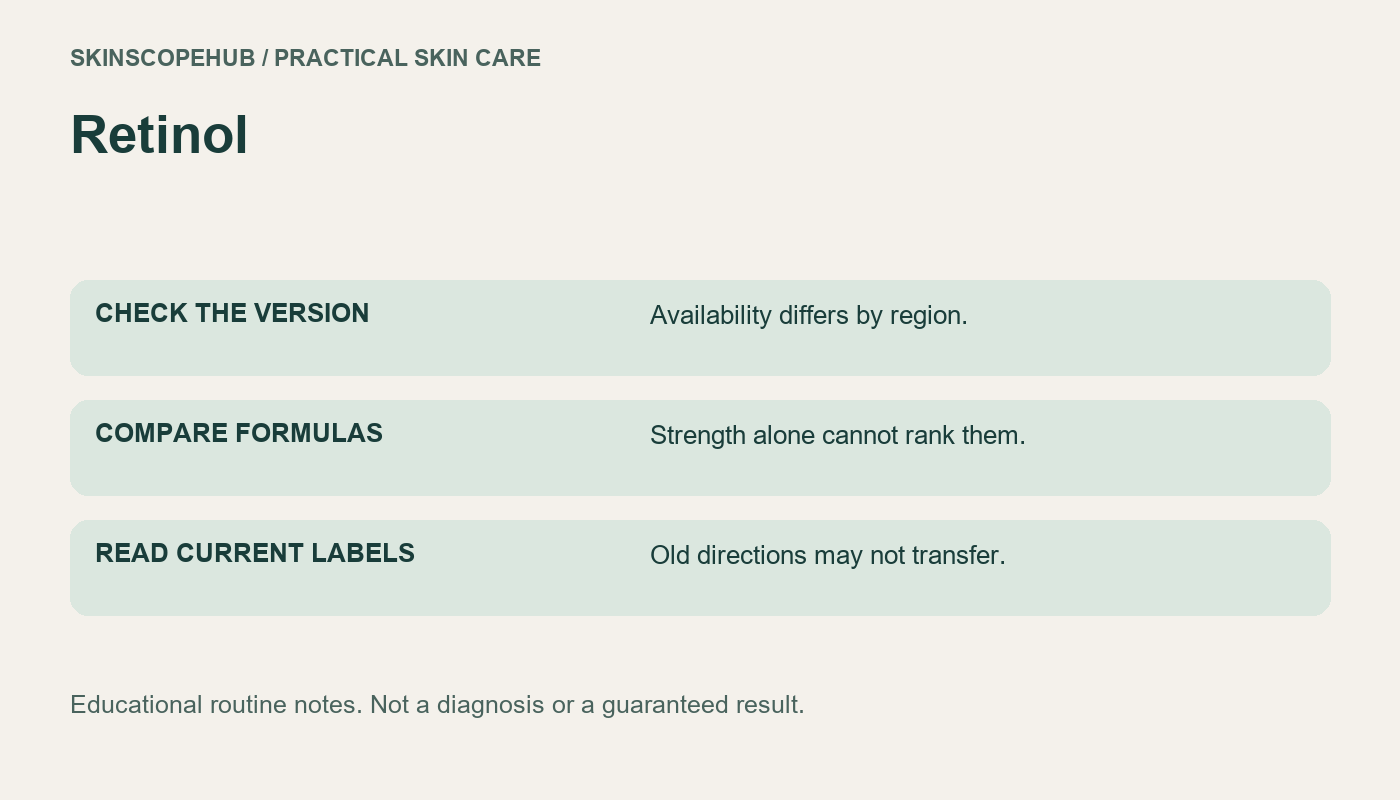
That replacement has a different name and retinoid combination. Do not assume it is a renamed bottle of the old 1% retinol formula or transfer the old directions to it. Check the current official local page and the package you actually buy.
The verified formula differences
| Detail | The Ordinary Retinol 0.5% in Squalane | Paula’s Choice CLINICAL 1% Retinol Treatment |
|---|---|---|
| Named retinol concentration | 0.5%. | 1% in the older formula. |
| Manufacturer-described format | Water-free, squalane-supported preparation. | Light hydrating lotion. |
| Other highlighted ingredients | Squalane. | Peptides and vitamin C. |
| Directions to check | Evening use; no other retinoid products; refrigerate after opening and use within three months. | Older European instructions describe a gradual introduction; do not apply them to replacement products. |
| Availability verified here | Official US product information reviewed; check local stock. | European page says the old formula has been discontinued; other markets were not confirmed. |
These are label and manufacturer-page details, not measured results from our testing. The named concentrations differ, so this is not an equal-strength experiment. Twice the headline concentration does not establish twice the visible benefit.
6 simple checks before choosing a retinol product
1. Confirm what is currently sold in your region
Check the exact product name, local seller, package, and current official page. A retailer may retain a listing after a brand changes its range. A search result snippet can also lag behind a discontinued formula, as the European 1% listing illustrates.
Do not infer global discontinuation from one regional page. Equally, do not assume a product is available locally because an older review recommends it. Ask the brand about the specific bottle if the version or storage history is unclear.
2. Compare concentration without treating it as a race
A 1% retinol preparation is not a necessary goal for every person. The complete formula, application frequency, amount, and your current skin condition affect tolerance. A milder product that you can use comfortably may be a more practical choice than one that repeatedly irritates.
The Ordinary describes its 0.5% product as an intermediate option and suggests starting with a lower-strength product. This is manufacturer guidance for that range, not a universal schedule that replaces individual advice.
3. Consider the vehicle and other ingredients
An oil-like water-free preparation and a lotion can feel different. Whether either suits your skin cannot be established from the ingredient headline alone. Fragrance, other actives, and the full local ingredient list can matter to someone with reactive skin.
Peptides or vitamin C in a formula do not prove that it outperforms every simpler retinol product. Our peptide evidence guide explains the difference between an ingredient mechanism and a finished-product result.
4. Read storage and use directions before buying
The Ordinary’s verified page calls for refrigeration after opening and use within three months. Consider whether you can follow those conditions and use the bottle appropriately. Do not apply that storage instruction to every retinol brand.
Use the actual bottle’s directions and expiration information. A discount on a poorly documented old product is not a reason to ignore storage history or version differences.
5. Review your current routine
The Ordinary’s directions say not to use its product with other retinoids and warn about irritation. Do not layer several retinol or other retinoid products because the names differ. Check prescribed treatments with the prescriber before adding a cosmetic retinoid.
Acids and other acne treatments can add irritation. Our salicylic acid and retinol guide explains why a combination needs tolerance review. If your face is already sore, use familiar gentle basics and our irritated skin routine while seeking advice when needed.
6. Define a realistic outcome
A cosmetic product may be chosen for the appearance of photoaging, but no brand comparison here establishes a fixed wrinkle reduction or deadline. We have not tested these formulas on users, measured their delivery, or compared clinical outcomes.
Our retinol and bakuchiol comparison discusses selected research. A study of different ingredients or preparations cannot be used to declare a winner between these two branded products.
Protection and reactions matter more than a brand winner
Use adequate suitable broad-spectrum SPF 30 or higher and follow reapplication directions, alongside shade and protective clothing. The AAD sunscreen FAQ explains protection requirements. A retinol serum does not replace sunscreen.
Both manufacturer sources advise avoiding retinol during pregnancy or breastfeeding. Ask your healthcare professional about suitable alternatives for your situation. Stop a newly introduced product causing persistent burning or a rash; significant swelling, blistering, severe pain, or eye involvement needs prompt care.
Common questions
Which brand is better?
No head-to-head outcome evidence reviewed here establishes a universal winner. Choose an available, suitable formula by directions, tolerance, and cost rather than the brand name alone.
Is the old Paula’s Choice 1% lotion still sold everywhere?
We verified that the European page says goodbye to the old formula. We could not confirm every market, so check your local official listing.
Does a replacement use the same directions?
Do not assume so. Different retinoids and formulas need their own labels. Confirm the current product rather than applying an old review’s schedule.
Sources and editorial basis
SkinScopeHub prepared this comparison from the linked manufacturer pages and AAD guidance. Manufacturer benefit statements are not independent proof of superiority. No personal trial or medical review of this article is claimed. See our medical disclaimer.