Niacinamide may be part of a comfortable moisturizing routine, but persistent facial redness needs a cause-based assessment. A serum cannot reliably diagnose or treat every form of redness, rosacea, eczema, irritation, or contact allergy. If your face is currently burning or covered by a new rash, avoid adding another optional product.
This guide explains six useful questions about redness and niacinamide. It separates cosmetic appearance claims from diagnosed conditions and offers a practical way to review product exposure.
Redness is a sign rather than a diagnosis
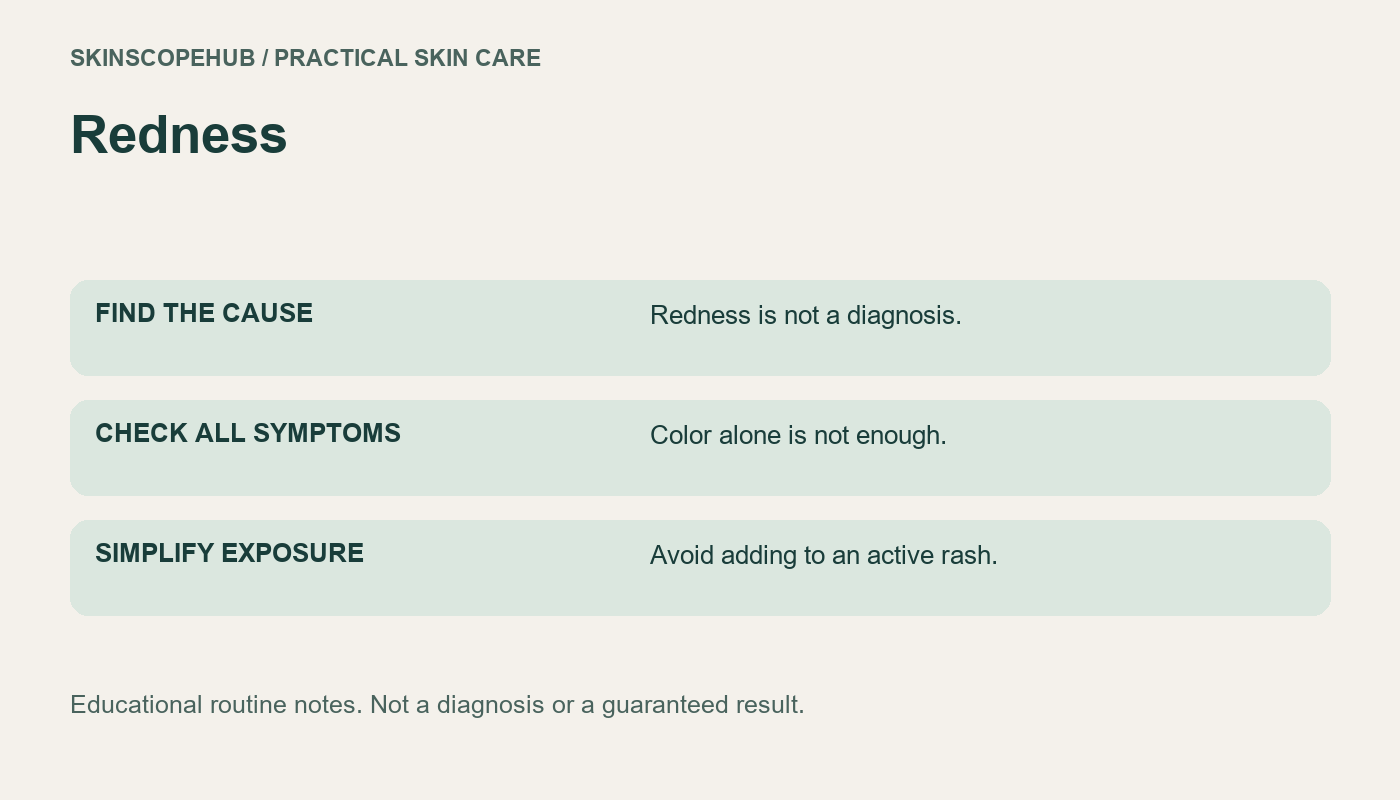
Flushing, irritation, eczema, rosacea, allergy, and other conditions can produce facial changes that look similar at home. Timing, warmth, itching, pain, scaling, and distribution all matter. A product recommendation cannot establish the cause from a photograph.
On darker skin tones, color changes may be harder to see or may look different from bright red. Warmth, swelling, tenderness, stinging, and changes in texture can still be important. Do not wait for a clearly red appearance before paying attention to discomfort.
DermNet’s irritant contact dermatitis guidance explains how exposures can damage and inflame skin. That supports reviewing a routine, but does not mean every red face is irritant dermatitis.
6 questions about niacinamide and redness
1. What claim is being made?
“Improves the appearance of uneven tone” is a cosmetic claim. “Treats rosacea” or “cures eczema” concerns a diagnosed condition and requires different evidence. Do not treat these statements as interchangeable when choosing a serum.
DermNet’s nicotinamide overview discusses topical niacinamide and research relevant to skin care. Potential barrier-supporting or anti-inflammatory roles do not establish a universal treatment for every cause of facial redness.
2. Did symptoms start after a product change?
Record newly introduced cleanser, sunscreen, serum, medicine, fragrance, or hair product. Consider increased frequency as well as a new bottle. Several changes together make it difficult to identify a relevant exposure.
Stop a newly introduced optional cosmetic that causes persistent burning, itching, or a rash. If a prescription may be involved, ask the prescriber how to proceed. Do not stop essential prescribed medicine without advice.
3. Is a niacinamide serum actually needed?
Your current moisturizer may already contain niacinamide or other ingredients that keep skin comfortable. A separate serum can be unnecessary. More products can increase the number of exposures you need to track.
Our daily routine audit explains how to check duplicates. A simple routine with familiar cleanser, moisturizer, and tolerated sunscreen can be a sensible starting point while you seek assessment.
4. Can the complete formula be tolerated?
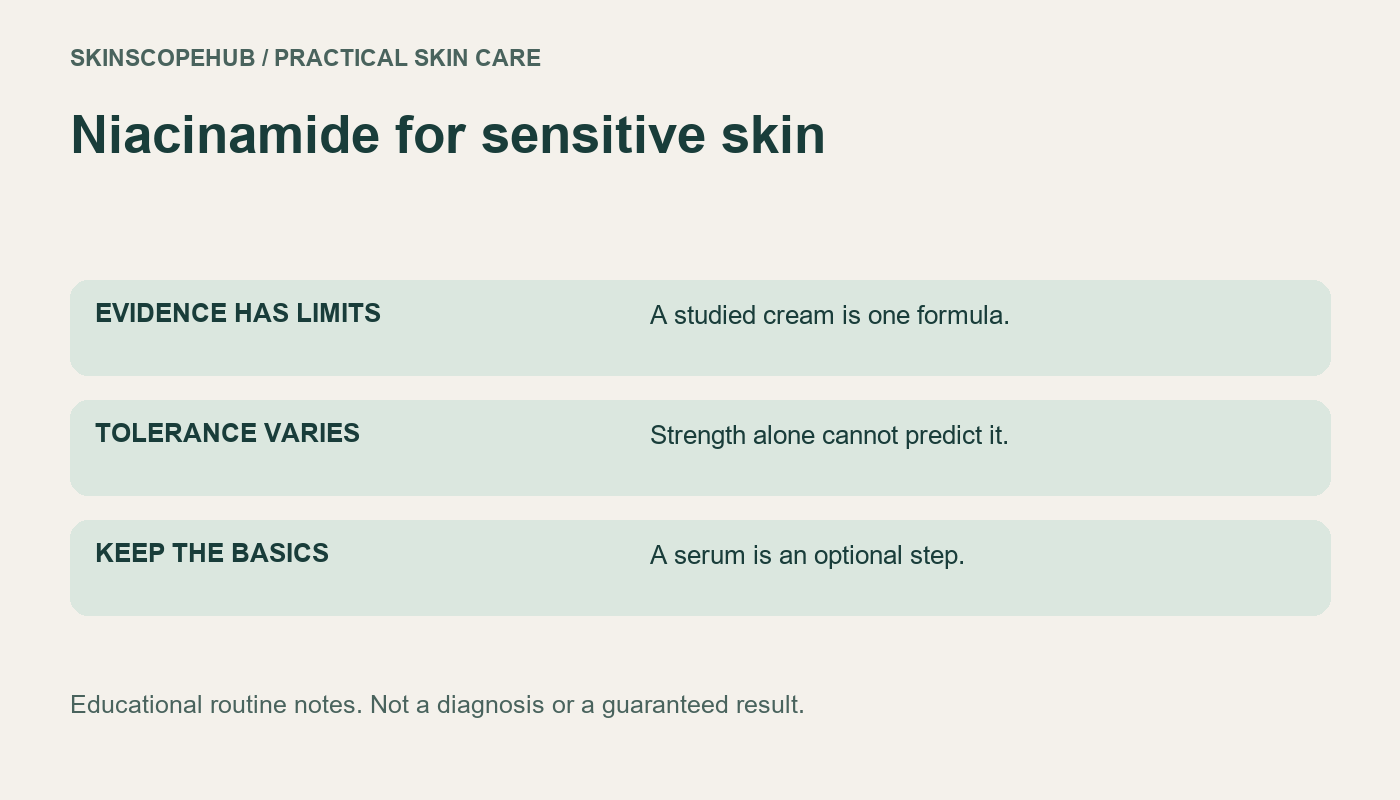
Niacinamide is only one ingredient in the bottle. Fragrance, other actives, the vehicle, and the condition of your skin can affect comfort. A “sensitive skin” label cannot guarantee tolerance or rule out a contact allergy.
A higher concentration is not a necessary goal. Our sensitive skin evidence guide discusses why selected studies cannot establish a universal safe percentage. Avoid putting a new serum onto actively irritated skin to test whether it calms the reaction.
5. How will a suitable product be introduced?
Once your skin is comfortable and a cosmetic step is appropriate, follow the label and change one exposure at a time. The AAD product testing guide describes a small-area home use test. It cannot rule out every reaction or replace medical patch testing.
Our niacinamide introduction guide explains product placement. Stop if discomfort persists; there is no requirement to reach twice-daily use.
6. When does the pattern need clinical advice?
Persistent or recurrent flushing, redness with pain or scaling, eye symptoms, or a rash that spreads deserves assessment. A clinician can examine the pattern, review exposures, and decide whether a condition-specific treatment is needed.
Seek prompt help for significant swelling, blistering, severe pain, or eye involvement. Trouble breathing or swelling of the lips, tongue, or throat requires emergency care. Do not repeatedly test a product that caused a severe reaction.
A useful symptom and exposure record
| Observation | What to record | Avoid assuming |
|---|---|---|
| Timing | When symptoms began and which products changed. | The last ingredient you read about is the cause. |
| Symptoms | Warmth, itching, stinging, swelling, or scaling. | Color alone defines severity. |
| Distribution | Areas affected and any eye symptoms. | Location alone establishes a diagnosis. |
| Exposure | Product names, amount, frequency, and medicines. | One active name describes the whole formula. |
This record can help a consultation, but it is not a diagnostic test. Occasional photographs in similar lighting may be useful; avoid repeated mirror checks under changing light that make trends harder to interpret.
Keep an irritated routine simple
Use familiar gentle products, avoid hot water and scrubbing, and moisturize where needed. Our skin barrier repair guide offers an example. It does not replace treatment for a diagnosed condition.
Keep sun protection with a tolerated suitable formula, shade, and protective clothing. Our sunscreen comparison explains options for reactive skin. A niacinamide serum does not replace adequate SPF.
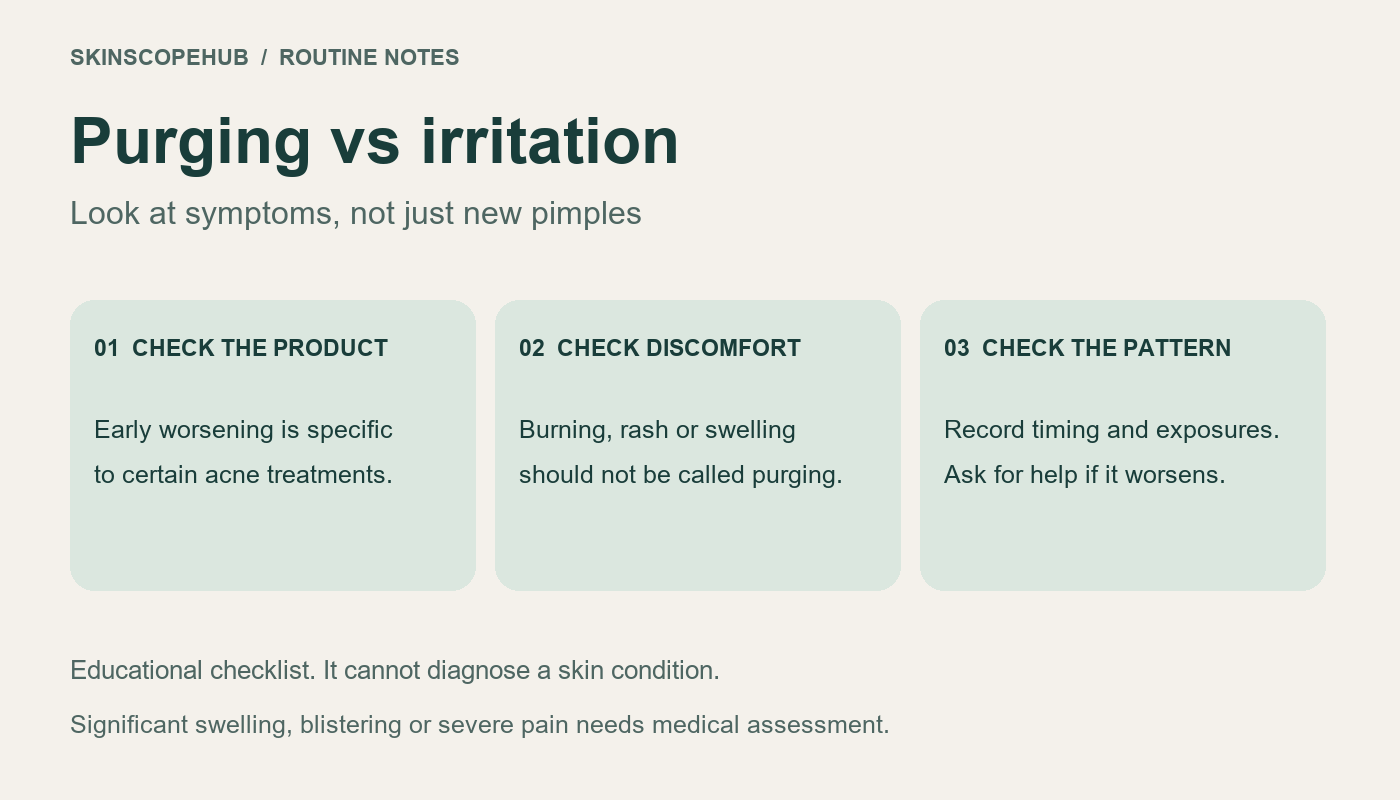
Avoid introducing acid, retinol, and a new serum together. If new spots accompany a reaction, read our purging versus irritation guide instead of assuming the skin must adapt through burning.
Common questions
Can niacinamide cure redness?
No universal cure claim is justified. Redness has several possible causes, and persistent symptoms need assessment.
Should I increase the percentage for faster calming?
No. More concentrated formulas are not automatically better tolerated or more appropriate. Focus on the complete product and the reason for symptoms.
Does stinging mean it is working?
No. Persistent stinging or a rash is a reason to stop the new exposure and reassess, rather than evidence of benefit.
Sources and editorial basis
SkinScopeHub prepared this guide using the linked DermNet and AAD guidance. No clinical treatment outcomes or medical review of this article are claimed. See our medical disclaimer.