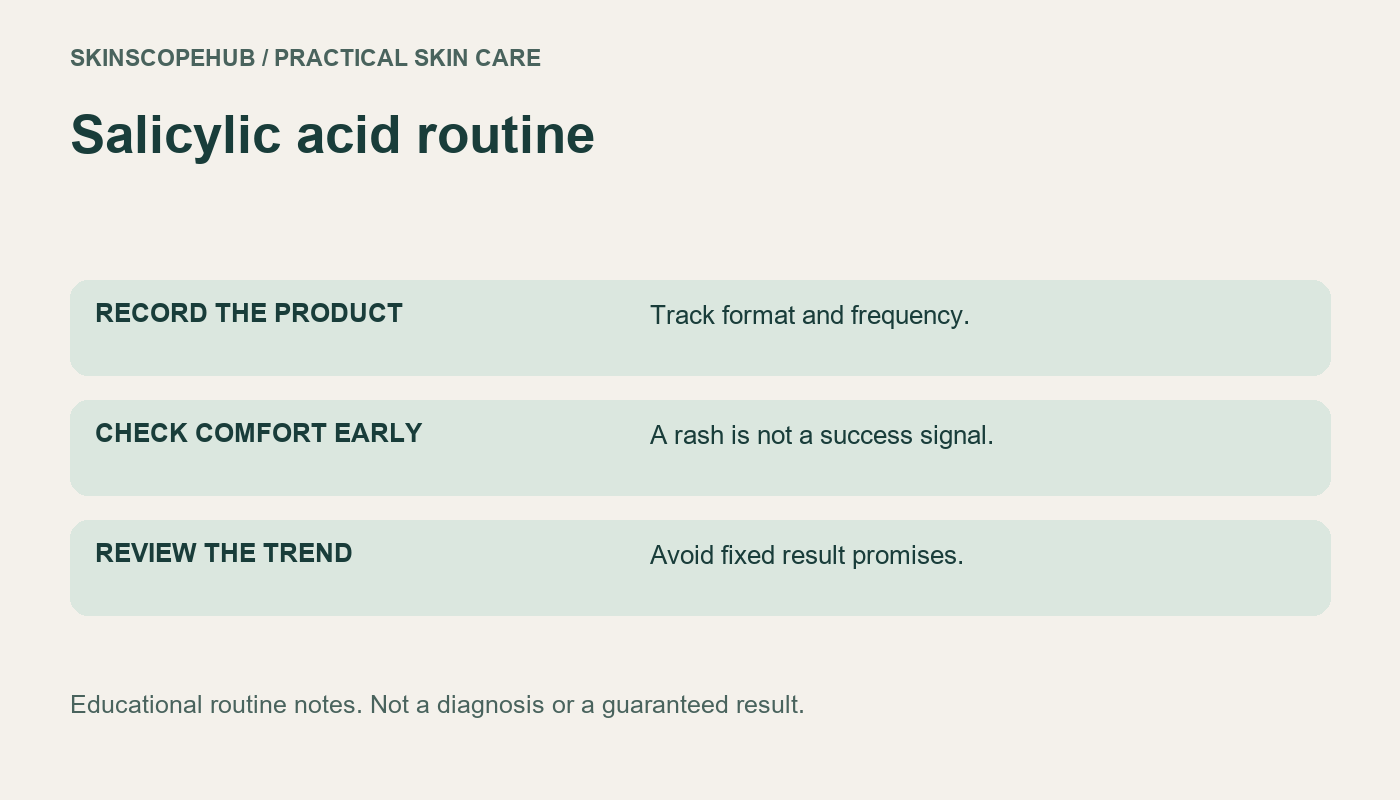
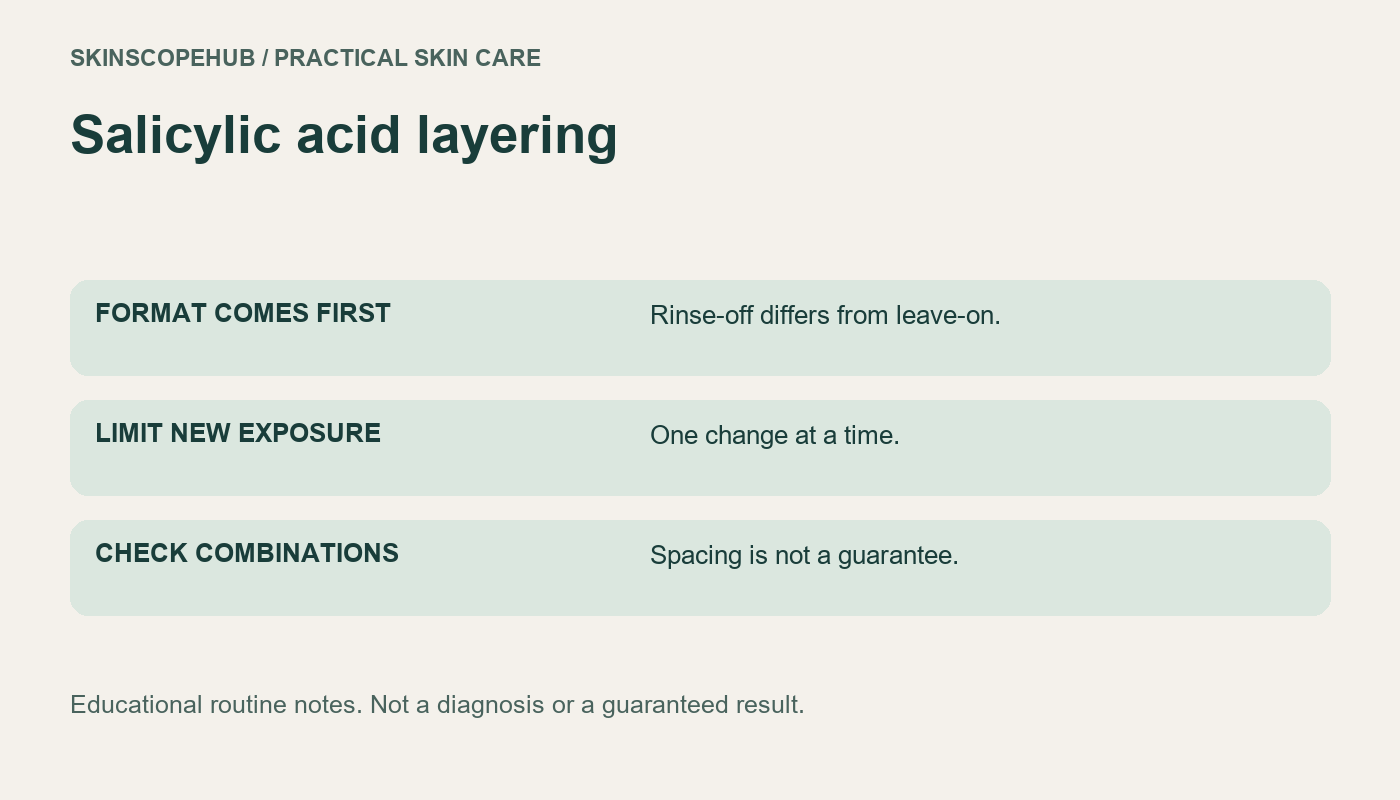
Salicylic acid layering depends on product format, label directions, and how much irritation your routine creates. A rinse-off cleanser goes before leave-on skin care; separate leave-on treatments may be better used at different times if their directions permit. You do not need salicylic acid, retinol, niacinamide, and vitamin C in the same routine.
This guide compares the three combinations and explains five checks before adding another layer. There is no universal waiting time or ingredient order that makes every combination safe.
Start with the actual products
DermNet describes salicylic acid as a keratolytic and stresses following the label. A cleanser, toner, spot treatment, and prescription preparation are different exposures even if they share an ingredient name.
List the exact bottles and their directions. Check whether your cleanser already contains salicylic acid before adding a leave-on acid. A marketing term such as “gentle toner” does not establish that its exfoliating effect is negligible.
5 checks before salicylic acid layering
1. Identify rinse-off and leave-on steps
Use and rinse a medicated cleanser as directed before applying leave-on products. Do not leave it on longer to simulate a serum. A leave-on acne treatment should be applied to the intended area and in the amount described on its label.
For optional cosmetic serums, texture can guide placement, but the actual directions take priority. A prescription instruction may differ from a general skin care suggestion; follow the prescriber rather than a generic layering chart.
2. Choose one new exposure
Keep familiar basics while introducing one product. Adding acid, retinol, and vitamin C together makes improvement or discomfort difficult to attribute. Record the formula and application schedule instead of just naming the active ingredient.
If your face is already burning, peeling, or covered by a new rash, simplify first. Our skin barrier repair routine explains why another serum can complicate an existing reaction.
3. Review overlapping irritation
Retinol and salicylic acid can both cause dryness or irritation. Some vitamin C formulas are acidic and may sting too. Niacinamide can be part of a well-tolerated product, but it does not cancel the irritating effects of other layers.
Do not use separate products together simply because a manufacturer sells a finished combination. A designed combination has its own formulation and directions; it is different from several independent bottles applied one after another.
4. Separate products when useful and permitted
Different times or days can make a routine easier to tolerate and interpret. For example, you might keep an optional cosmetic step away from an exfoliating product when both labels allow it. This is a scheduling option, not a clinical guarantee or a universal prescription.
Spacing does not make an unsuitable product appropriate. Ask a clinician or pharmacist before combining medicines, treating extensive areas, or changing a prescribed schedule.
5. Keep moisturizing and sun protection
Use a tolerated moisturizer when needed, including on oily skin. Avoid scrubs and brushes that add abrasion. The AAD acne guidance explains why scrubbing and excessive washing can worsen acne.
Use adequate broad-spectrum SPF 30 or higher and follow reapplication directions. Neither a niacinamide serum nor vitamin C replaces this protection. Our sunscreen guide helps compare suitable textures.
Compare the three combinations
Salicylic acid with niacinamide
The ingredients can appear together in finished products, and separate suitable products may fit a routine. There is no universal rule that niacinamide must always come first or that every combination requires a thirty-minute wait.
A salicylic cleanser is rinsed off before a niacinamide serum; niacinamide in a moisturizer goes at the moisturizing step. Our which goes first guide focuses on these format differences. If niacinamide is already in a comfortable cream, a separate serum is optional.
Salicylic acid with retinol
Tolerance is the main practical concern. Introducing both together or increasing both schedules at once can make dryness difficult to manage. A retinol product’s directions and any prescription instructions take priority.
Do not assume that alternating days will suit every person. Review suitability and ask for help when needed. Our salicylic acid and retinol guide provides a focused discussion of the combination.
Salicylic acid with vitamin C
Vitamin C products vary by form and vehicle. An acidic serum, derivative-based cream, and combination formula are not interchangeable. Some combinations may feel uncomfortable even if their ingredients are not categorically incompatible.
Follow directions and consider separate use if permitted and helpful. Our vitamin C serum guide explains formulation and pigmentation goals. Do not increase exfoliation to force faster fading of marks.
A simple decision path for salicylic acid layering
First, define the concern: clogged pores, inflammatory acne, dryness, or pigmentation are different goals. Second, choose one product that addresses that goal and fits your current routine. Third, check the label and existing medicines before adding another active.
If the routine works comfortably, an additional layer needs a clear purpose. If it causes persistent stinging or a rash, stop the new exposure and reassess. Our irritation checklist explains why new spots are not automatically purging.
Common questions
Do I need to measure my skin’s pH?
No home measurement can establish a universal layering order. Finished formulas and directions are more useful than a blanket rule based only on ingredient names.
Is waiting between steps mandatory?
Follow any waiting instruction on the product. Without such an instruction, there is no universal interval that guarantees compatibility or prevents irritation.
Can I use all four ingredients every night?
There is no need to. Assess each product’s purpose, instructions, and tolerance. A simpler routine may meet your goals with fewer opportunities for discomfort.
When should I get advice?
Persistent reactions, deep painful acne, and scarring deserve assessment. Significant swelling, blistering, severe pain, or eye involvement needs prompt care.
Sources and editorial basis
SkinScopeHub prepared these product-format examples using the linked DermNet and AAD guidance. They are not prescriptions or results from product testing. The article has not been medically reviewed; see our medical disclaimer.