Purging vs irritation cannot be decided from the number of new pimples alone. Some acne medicines can cause early worsening, but burning, swelling, an itchy rash, or worsening discomfort should not be dismissed as a necessary step toward clear skin. A new moisturizer or niacinamide serum does not automatically cause “purging” just because you broke out after using it.
Start with what changed, which symptoms appeared, and what the product instructions say. This guide offers seven clues to discuss with a clinician, explains what to do with an uncomfortable reaction, and separates acne treatment timelines from advice about tolerating irritation.
Prepared by SkinScopeHub using the AAD, DermNet, and MedlinePlus sources linked below. These clues are educational and cannot diagnose a rash, allergy, or acne subtype.
What people mean by skin purging
“Purging” is an informal term for early worsening of acne after starting certain treatments that affect clogged pores and skin-cell turnover. It is not skin releasing toxins. It is also not a diagnosis that explains every new bump after changing a routine.
There is a specific example in MedlinePlus guidance for topical tretinoin: acne can initially worsen during early use. That medicine-specific advice does not establish a standard purging window for every retinol serum, exfoliant, or moisturizer.
For purging vs irritation, two processes can overlap. An acne treatment can affect breakouts and irritate skin at the same time. Even a familiar ingredient can become uncomfortable when used more often, at a stronger concentration, or alongside another irritating treatment.
Purging vs irritation: 7 clues to check
1. Check the product, not just the ingredient headline
Write down the exact product, concentration where stated, and whether it is a rinse-off or leave-on formula. Prescription tretinoin has different instructions from cosmetic retinol. A cleanser and a leave-on salicylic acid treatment also produce different exposures.
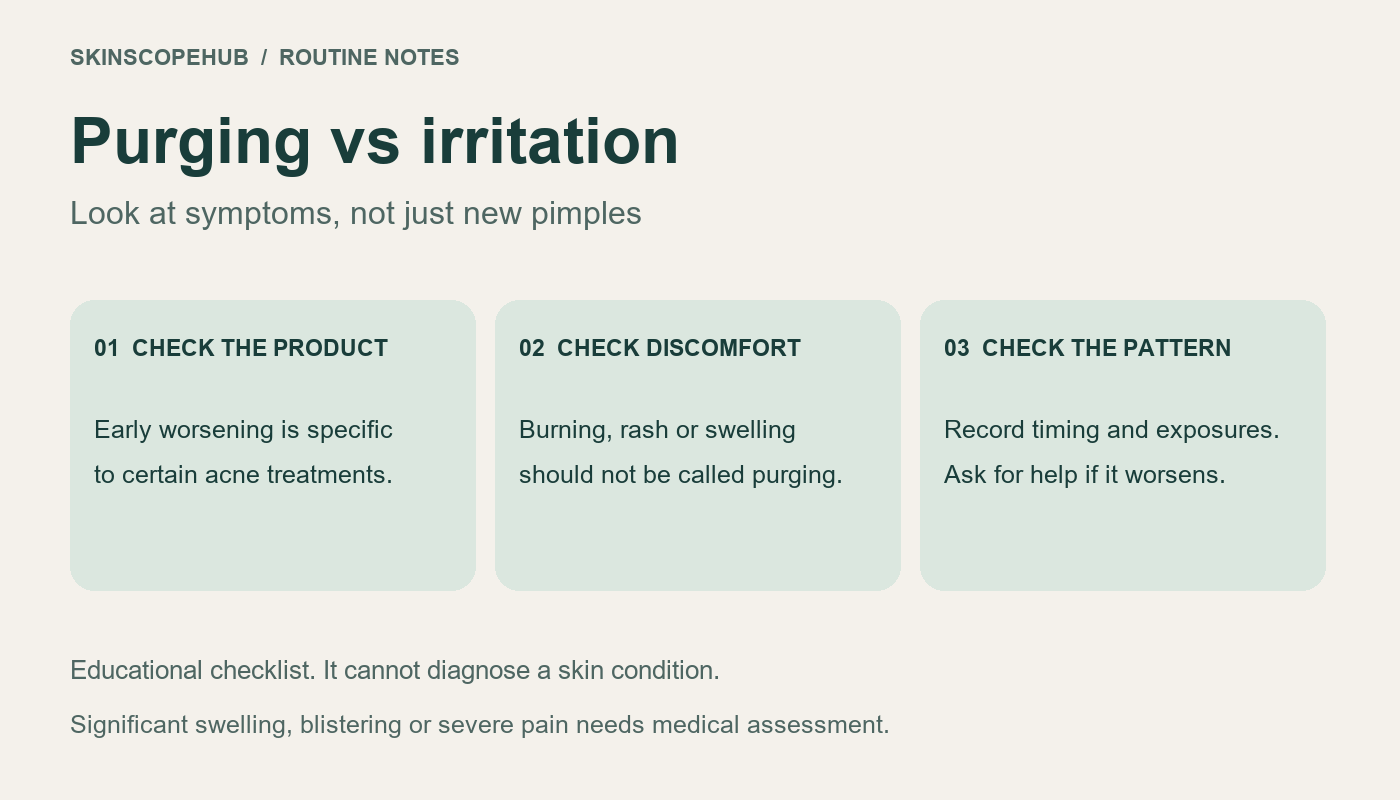
Ask whether early acne worsening is actually described for that treatment. If a moisturizer, sunscreen, or simple hydrating serum is followed by new spots, do not assume purging. The formula may not suit your skin, the timing may be coincidental, or another change may be involved.
2. Describe the discomfort
Distinguish pimples from burning, stinging, tenderness, or an itchy rash. DermNet notes that burning and pain are common in irritant contact dermatitis. These symptoms are useful reasons to reconsider exposure, although they cannot tell you whether the cause is irritation, allergy, or another condition.
When comparing purging vs irritation, persistent discomfort matters more than a social-media rule that says a certain number of weeks is “normal.” Significant swelling, blistering, or severe pain calls for medical assessment rather than a stronger moisturizer layered over the trigger.
3. Look beyond your usual acne areas
New acne-like bumps where you commonly break out can be compatible with several explanations, including ordinary acne variation. They do not prove that a product is working. A rash on the eyelids, around the neck, or across previously comfortable areas deserves a different level of attention.
Location helps a clinician understand the pattern, but it is not a home diagnostic test. Contact with hair products, masks, or hands can change the distribution. Record where symptoms appear and whether the product touched those areas.
4. Notice the type of skin change
A whitehead, a deep painful lump, a patch of scaling, and a cluster of itchy bumps should not all be described simply as “breakouts.” Take note of flaking, cracks, weeping, hives, or swelling as well as spots.
Colour changes vary with skin tone. Redness may be obvious on lighter skin and appear brown, purple, grey, or less visible on darker skin. Burning or tenderness can still be important when visible redness is subtle. Avoid diagnosing “fungal acne” from a photograph alone.
5. Review timing without treating it as proof
Symptoms beginning soon after an application make the product worth examining. Reactions can also develop after repeated use. There is no single timing threshold that reliably separates purging vs irritation for all ingredients and all skin types.
Note the first application, frequency increases, and the first day of symptoms. If multiple products changed together, you cannot confidently assign the reaction to one of them. Simplifying the routine is more informative than adding further actives to “speed up” the process.
6. Check the total exposure
A routine with an acid cleanser, exfoliating toner, retinol, and scrub can be irritating even when each product has reasonable instructions on its own. More frequent use, application to damp skin where directions advise otherwise, or covering an active with a heavy ointment can also change exposure.
Read our salicylic acid and retinol guide for background on combining actives. If you already feel sore or flaky, your next step is to review the combination rather than add another treatment.
7. Track whether the pattern is improving or escalating
Keep simple notes and, if useful, photos in similar lighting. Are ordinary products becoming comfortable again? Is the rash spreading? Are new painful lesions appearing? A worsening trend or repeated reaction is a reason to contact a clinician.
An improvement after stopping a product is useful information, but it does not prove which ingredient caused the problem. Do not deliberately reapply a product that caused a severe reaction to confirm your theory. Bring the ingredient list to your appointment instead.
A practical comparison, with limits
| Observation | What it may suggest | What it cannot prove |
|---|---|---|
| More acne lesions after starting a treatment known for early worsening | A treatment-related early flare is possible; follow the specific instructions and discuss concerns with the prescriber. | That every new lesion is purging, or that severe discomfort is safe. |
| Burning, widespread dryness, or painful scaling | Irritation is a concern; review the product and overall routine. | The exact cause or whether allergy is also involved. |
| Itchy rash, hives, or swelling | A reaction needs attention; significant or rapidly worsening symptoms need prompt care. | A reliable diagnosis from appearance alone. |
| Spots after a moisturizer or sunscreen | Formula suitability, other exposures, and normal acne variation are possibilities. | That the product is “detoxing” the skin. |
Use this table to organize information rather than to label yourself. Purging vs irritation is often less useful as a binary choice than asking whether the current treatment is tolerable, correctly used, and appropriate for the condition you actually have.
What to do when a new product makes skin uncomfortable
For a mild reaction to a new nonprescription product, stop that product and return to a simple routine with familiar gentle cleansing and moisturizer. Avoid scrubs and optional actives while skin is sore. Our skin barrier repair guide gives a practical morning and evening example.
If a prescription acne treatment causes problems, ask the prescriber how to adjust it. Do not use this article to override the label or instructions, and do not assume that more frequent application gives faster results. The amount and schedule are part of the treatment.
Seek prompt medical advice for blistering, significant swelling, severe pain, a spreading rash, or eye involvement. Difficulty breathing or swelling of the lips, tongue, or throat needs emergency help. Persistent, scarring, or deep painful acne also deserves professional assessment.
How long should you give an acne treatment?
The AAD’s acne skin care guidance recommends giving an appropriate acne product six to eight weeks to see some improvement, with complete clearing often taking longer. That advice concerns treatment effectiveness. It is not an instruction to tolerate a rash or escalating irritation for eight weeks.
Follow the medicine-specific instructions and planned review date when you have a prescribed treatment. For nonprescription products, review lack of improvement rather than cycling through a new treatment every few days. Switching too quickly can create irritation and make the results difficult to interpret.
There is no validated universal “purging ends on day 28” rule. Expectations for one medicine cannot simply be transferred to another ingredient. If your symptoms do not match the expected effects in the product guidance, ask for help before extending the trial.
How to introduce products more clearly next time
Introduce one new product while keeping the rest of the routine stable. Follow directions for amount and frequency. Start during a period when you can observe changes, rather than just before an event when discomfort will be harder to manage.
The AAD recommends testing a suitable new skin care product on a small area, usually twice daily for seven to ten days using normal amounts and appropriate rinse-off directions. This cannot predict every facial reaction or acne flare and is different from a dermatologist’s patch testing for allergy.
Do not apply that general test schedule to increase the frequency of an acid or retinoid beyond its instructions. For more ingredient background, read what niacinamide does and starting salicylic acid. Ingredient knowledge is useful, but your tolerance still depends on the finished product and routine.
Frequently asked questions about purging vs irritation
Does niacinamide cause purging?
Do not assume that it does. Niacinamide is not an exfoliating acid or a retinoid, and a reaction after a niacinamide product needs the same careful review as any other new formula. Check discomfort, concentration, and other ingredients rather than continuing automatically.
Can salicylic acid cause new spots?
New spots can appear during use, but their cause cannot be established from timing alone. Salicylic acid can also irritate skin. Review the directions, other actives, and symptoms. Burning or a rash is not evidence that blocked pores are clearing.
Is a small-area product test the same as medical patch testing?
No. A home use test may reveal a reaction to a product. Medical patch testing uses a clinician’s protocol to investigate contact allergy. A negative home test does not rule out allergy or guarantee that the face will tolerate the product.
Should I keep going if the acne looks worse but nothing stings?
Check the guidance for that specific treatment and contact the prescriber if concerned. Absence of stinging does not prove purging. Painful, scarring, persistent, or rapidly worsening acne needs assessment even when the surrounding skin feels comfortable.
Sources and editorial basis
- MedlinePlus: Tretinoin topical drug information.
- DermNet: Irritant contact dermatitis.
- American Academy of Dermatology: 10 skin care habits that can worsen acne.
- American Academy of Dermatology: How to test skin care products.
This is a synthesis of the linked sources, including DermNet’s dermatitis overview. The checklist is an editorial aid, not a validated diagnostic test. No first-hand clinical testing or medical review is claimed. Read our medical disclaimer.